
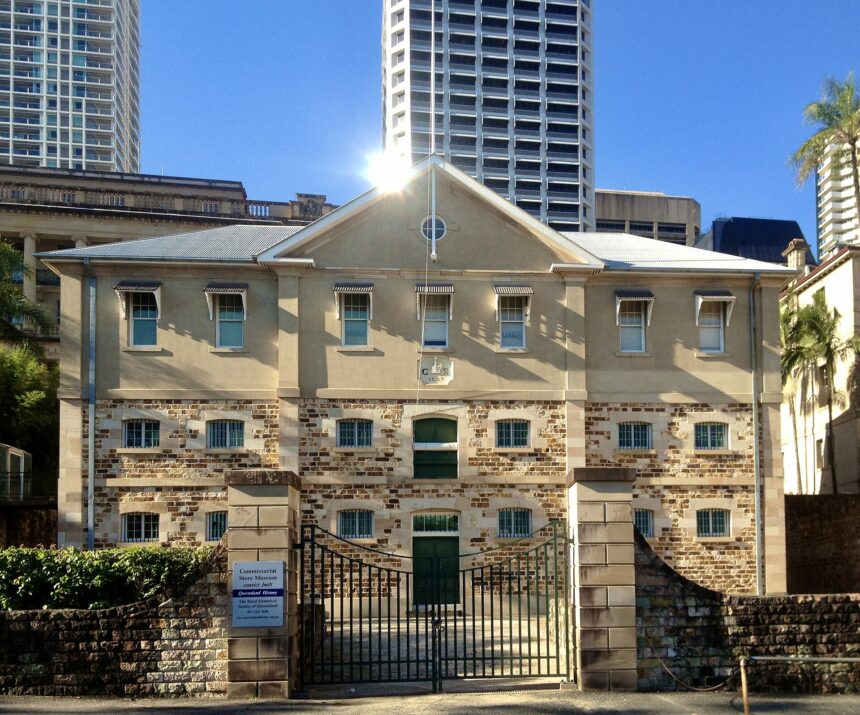
At 10 November 2026, the museum’s home page gave its address as 115 William St, Brisbane, 4000. The same page described the Commissariat Store as a niche museum that specialises in showcasing Queensland’s history. It also described the museum as an initiative of the Royal Historical Society of Queensland, staffed by volunteers from the Society. This guide follows the building’s history, naming the source of each claim, and it reports where sources differ without choosing between them.
- Moreton Bay and the penal settlement
- Building the store, 1828 to 1829
- What the Commissariat did
- After the penal settlement
- Government stores and the third storey
- Restoration and the Royal Historical Society
- Heritage status and where the sources differ
- The museum as its home page described it
- Frequently asked questions
Moreton Bay and the penal settlement
The museum’s building-history page says that in 1824 the Governor of New South Wales, Sir Thomas Brisbane, gave instructions to establish a new penal settlement in Moreton Bay. The page says re-offending convicts from New South Wales were sent to remote stations to do the most menial labour on a rigidly-set, monotonous and minimum diet. It adds that punishment was the focus of the new, secondary penal stations. The Wikipedia article on the building, last edited 18 July 2026 and stating that it was originally based on Queensland Heritage Register text, says that in 1826 Captain Patrick Logan arrived as Commandant and began a works program that replaced key buildings with more substantial structures made of stone and brick.
Building the store, 1828 to 1829
The museum’s home page says the lower two floors were convict built during 1828 and 1829, as it read on 10 November 2026. The building-history page says the stone building, commissioned by Commandant Patrick Logan, was completed in 1829. Wikipedia says the design was by William John Dumaresq, whose plans arrived from Sydney in April 1828. It says the store was built of Brisbane tuff from the quarry at the Kangaroo Point Cliffs, with sandstone from Oxley Creek used for footings, the base course, quoins, sills and lintels. The same article says the excavation work was heavy and carried out by the Gaol Gang of convicts as a specific punishment. It also says the windows were small, unglazed and barred for security and the roof was clad with ironbark shingles.
What the Commissariat did
The building-history page says the Commissariat’s primary role was to procure, store and distribute provisions to the military, convicts and colonists. The page says the Commissariat also controlled the supply of hospital requisites and equipment, customs and banking.
After the penal settlement
The building-history page says that in 1839 the costly penal settlement was effectively closed and the bulk of the convict population removed. Wikipedia says the penal colony closed in 1839 and Moreton Bay was declared open for free settlement in 1842. The museum’s page says the Store became a land sales office and then a depot for immigrants unable to be accommodated in the former Military Barracks. Wikipedia gives more detail, saying the upper floor was used for land sales in 1848 and intermittently to house immigrants during the 1850s. It adds that the immigrant use is likely to have stopped only when the new Yungaba Immigration Centre opened at Kangaroo Point in 1887.
The museum’s page says a separate kitchen building was constructed in the yard. It says that in 1860 the building was renamed the Colonial Stores. The first floor was converted into a police barracks, according to the page, while the ground floor remained a storeroom. The page says an inventory of supplies listed items such as cutlery, paper, candles, police clothing, saddlery and blankets for “the Aborigines”, which is the page’s own wording. It also says a brick storekeeper’s cottage, saddle store, stables and stationery annex were later constructed in the yard. Wikipedia says that during the “Bread and Blood” riots of 1866 an attempt was made to force entry to the store, possibly because it was seen as a symbol of government and its control of essentials.
Government stores and the third storey
The museum’s page says that from the mid-1880s the building was converted into sundry government offices and renamed the Government Stores. Wikipedia gives a different date for the renaming, saying that in 1898, as the Federation of Australia approached, the building was renamed the Government Stores. The museum’s page adds that various additions were constructed to provide more workspace. It says a third storey, approached by a gangway from William Street, was added in 1913. At 10 November 2026 the home page described the third floor as now the main entrance from William Street.
Wikipedia says that by 1911 an additional storey was designed by Leonard Kempster, an architect for the Department of Public Works. It says contractor William Kitchen oversaw construction of the new addition, completed in 1913. The same article says the Queensland Government created the State Stores Board on 23 March 1923. It says the building was renamed the State Stores Building and was eventually vacated by the board on 12 September 1960. It adds that Queensland State Archives then occupied the ground floor until 1968 and various government departments used the upper floors.
Restoration and the Royal Historical Society
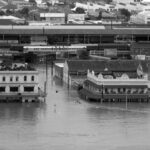
Wikipedia says that before restoration began in 1978 an archaeological excavation was conducted by the Queensland Museum. The museum’s building-history page says that, following renovations in 1978, the building became the headquarters of the Royal Historical Society of Queensland in 1981. Wikipedia says the building was officially opened as the society’s headquarters on 24 November 1982. It says a later restoration by the Department of Public Works followed from 1998 to 2001. The article also says the store was damaged by a burst water main during the flood of January 2011. It says an archaeological salvage project recovered 8579 artefacts from the debris.
Heritage status and where the sources differ
Wikipedia says the Commissariat Store was listed on the Queensland Heritage Register on 21 October 1992. A Queensland State Archives blog post of 18 September 2024 says instead that the building was added to the register in 1978. The two named sources give different years, and this guide does not choose between them.
At 10 November 2026 the museum’s home page described the building as Queensland’s oldest habitable, and most significant heritage building. Wikipedia’s heritage-listing section says the store is one of only two buildings surviving from the Moreton Bay penal colony. The same text says it is one of only eight convict-built commissariat buildings remaining in Australia. Brisbane Open House’s listing gives a different count, saying the store is one of only four such buildings surviving in Australia. Wikipedia also says the remaining stone retaining walls around the store and fronting Queens Wharf Road along part of Miller Park are the only examples remaining in Queensland that were built by convicts.
The museum as its home page described it
At 10 November 2026 the home page said the ground floor features several handcrafted, detailed models of buildings from the early colony of Queensland, arranged in a street layout. It said the ground floor included the Moreton Bay Panorama and Tom Petrie interactive displays, which it called the latest addition to the museum. It said numbered panels on the ground floor are numbered from a previous archaeological dig, and that some of the items from that dig are on display on the middle floor. It said the middle floor holds what it called the infamous “Convict Finger”. It said the top floor contains the first of the museum’s rotating exhibitions on aspects of Queensland’s history.
This guide does not cover opening hours, prices, tours or events.
Related guides on this site: Brisbane Convict Origins: Moreton Bay Penal Settlement; Old Windmill Wickham Terrace Brisbane: History Guide; Yungaba Immigration Depot Kangaroo Point: History of a Migrant Hostel; Brisbane Heritage-Listed Buildings Guide.
Frequently asked questions
When was the Commissariat Store completed?
The museum’s building-history page, read on 10 November 2026, says the stone building, commissioned by Commandant Patrick Logan, was completed in 1829.
Who runs the Commissariat Store Museum?
At 10 November 2026 the museum’s home page described it as an initiative of the Royal Historical Society of Queensland, staffed by volunteers from the Society.
What was the Commissariat for?
The museum’s building-history page, read on 10 November 2026, says the Commissariat’s primary role was to procure, store and distribute provisions to the military, convicts and colonists.
When was it listed on the Queensland Heritage Register?
The sources read on 10 November 2026 differ: Wikipedia says 21 October 1992, while a Queensland State Archives blog post of 18 September 2024 says 1978.