
The long push for a Kangaroo Point crossing
Queensland State Archives (QSA) says public meetings calling for a bridge between northern Brisbane and Kangaroo Point began as early as November 1888. By the 1920s the Victoria Bridge remained the sole inner-city river crossing, according to QSA. QSA adds that a 1926 report by the Cross River Commission, chaired by engineer Roger Hawken, recommended the creation of several new bridges.
The New Farm and Districts Historical Society tells the 1926 step differently. It says the new Brisbane City Council recommended a bridge linking Kangaroo Point to the northern suburbs in 1926, but that it was not until 1932 that the Forgan Smith State Government decided to push ahead. Queensland Museum says the bridge was approved in principle in 1932, while QSA says the Labor Government permitted a Bridge Board in 1933 to plan a government-constructed toll bridge at Kangaroo Point. These accounts give different bodies and years for the early decisions, and this article does not reconcile them.
Design and contractors
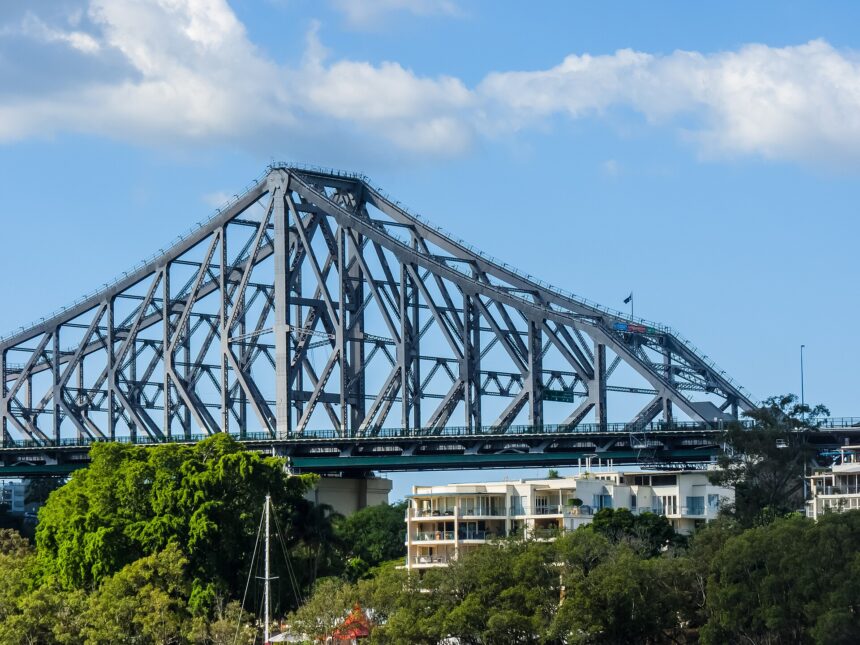
QSA says the design was completed by Dr John Bradfield, a Brisbane-born engineer who had spent much of his life working in New South Wales. Queensland Museum says the government moved to appoint J.J.C. Bradfield as consulting engineer after his work on the Sydney Harbour Bridge. Two sources describe the cantilever design’s link to Montreal. Queensland Museum says it was said to have been modelled on the Jacques Cartier Bridge, and the historical society says the design was influenced by that bridge, of 1930.
QSA says Evans Deakin-Hornibrook Constructions Pty Ltd won the contract to build the proposed six-lane bridge in early 1935, with a bid of 1.15 million pounds. Queensland Museum names the builders as Queensland companies Hornibrook Pty Ltd and Evans, Deakin and Co, with the works supervised by engineer JA Holt. The historical society says the bridge was almost entirely made of Australian steel fabricated locally by Evans Deakin.
Construction from 1935 to 1939
QSA says construction officially began on 24 May 1935, when Premier Forgan Smith laid the first stone, in commemoration of King George V’s 25th anniversary of acceding to the throne. Queensland Museum describes the same day as the turning of the first sod by Premier William Forgan-Smith. QSA says 400 people were employed on the build at the peak of construction in 1938.
QSA says the deepest foundation at the south pier, more than 30 metres below ground level, required men to work in conditions up to four times normal air pressure. The historical society says the southern main pier foundations reach 40 metres below park level. The two sources give different depths, and this article quotes each as stated.
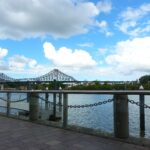
QSA says three workers and one citizen climber lost their lives on the bridge during construction. It names Arthur McKay Wharton as one of the workers who fell to his death, a 34-metre fall on 6 December 1939. The historical society says the gap in the structure was completed on 28 October 1939, after a delay while construction ceased to wait for the right weather to make the join.
How the bridge got its name
QSA says that during the build the bridge was first called the Brisbane River Bridge and later the Jubilee Bridge, and that in 1937 Cabinet decided to name it after John Douglas Story. Queensland Museum says construction was well underway by the time the name Story Bridge was announced in February 1937. QSA describes Story as a public servant and Vice-Chancellor of the University of Queensland. Council’s heritage places page lists Kangaroo Point Bridge and Jubilee Bridge as other names for the place.
Opening in 1940 and the toll years
QSA says the cantilever bridge was officially opened on 6 July 1940 by Governor Sir Leslie Orme Wilson, to a crowd of 37,000 people. Queensland Museum says the opening included the unveiling of two plaques, one for the Governor and one for the Premier to mark the first sod. It adds that church heads including Archbishop Duhig and Archbishop Wand felt the religious institutions had been slighted.
QSA says a toll booth was established at opening to help the State Government with loan repayments, and that the toll for a motor car was sixpence. It says the presence of American troops in Brisbane during the Second World War helped to pay off the costs, and that the toll was removed by 1947. Brisbane City Council says it has been responsible for maintaining the bridge since it was transferred from the Queensland Government to Council in 1947.
Cost and records
Brisbane City Council says construction began on 24 May 1935, took 5 years and cost 1.6 million pounds. That is higher than the 1.15 million pound bid QSA reports, and the sources reviewed do not explain the difference. Council describes the bridge as Australia’s longest cantilever bridge, whereas Queensland Museum says it was recognised, in its heritage listing, as the largest span metal truss bridge in Australia. These are different descriptions, so each is credited to its publisher.
Floods, ferries and a divided suburb
Queensland Places says city workers had three steam ferries from Edward and Creek Streets and the Customs House, and after 1940 also had the Story Bridge crossing. It says Bradfield designed the bridge with a high clearance, having in mind the need for ships to pass under it, and that in the 1974 flood the bridge was the only river crossing not blocked by rising waters. The same entry says that to many the roar of overhead traffic along Bradfield Highway signified the despoilation of Kangaroo Point, which the bridge approaches had cut in two.
Anniversaries and heritage listing
Queensland Museum says the 50th anniversary on 6 July 1990 saw a commemorative plaque laid by Lord Mayor Sallyanne Atkinson, and says the bridge was again closed to traffic to allow pedestrians to walk across. On heritage listing, Council’s heritage places page gives 21 October 1992 as the date of entry on the Queensland Heritage Register. Queensland Museum says the listing came just two years after the 75th anniversary, which it places in 2015. Those dates differ, and the register entry itself could not be read for this article.
Related reading
For other crossings see Brisbane Bridges: A History and Walter Taylor Bridge Indooroopilly: History of the Toll Bridge. For views of the bridge see Brisbane Lookouts and Viewpoints, and for the waterfront setting see Brisbane Riverwalk Guide.
Frequently asked questions
When was the Story Bridge officially opened?
QSA says the cantilever bridge was officially opened on 6 July 1940 by Governor Sir Leslie Orme Wilson.
Who designed the Story Bridge?
QSA says the design was completed by Dr John Bradfield, and Queensland Museum says the government appointed J.J.C. Bradfield as consulting engineer.
How much did the Story Bridge cost?
Brisbane City Council says it cost 1.6 million pounds, while QSA reports a winning contract bid of 1.15 million pounds. The sources reviewed do not explain the difference.