
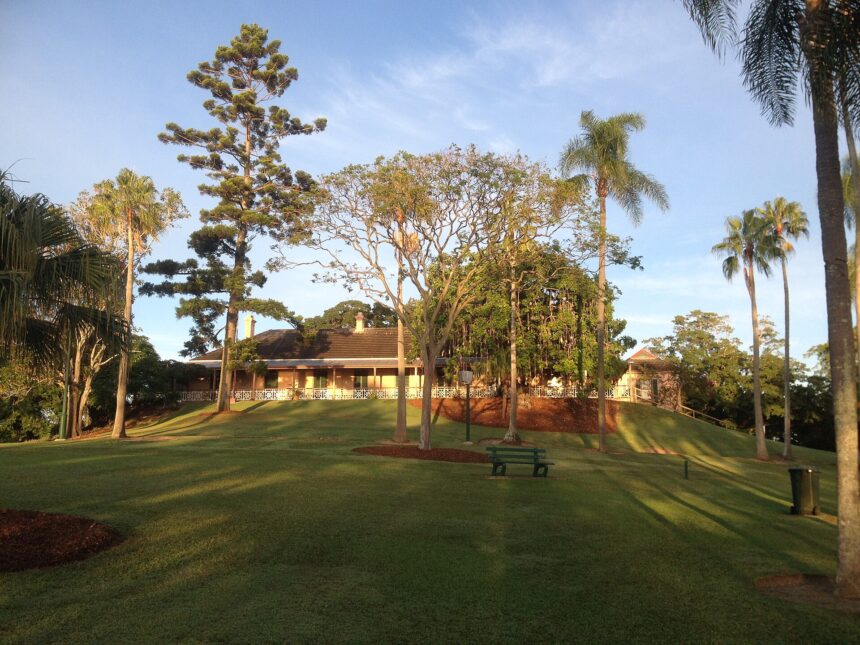
As at the operator’s About page captured on 2026-11-09, Newstead House was described as Brisbane’s oldest surviving European home and as a house museum. The sections below move from the landscape before the house, through its private owners, to its purchase by Brisbane City Council.
Before the house
As at the operator’s About page captured on 2026-11-09, the headland now known as Newstead Point was described as a place of gathering, sustenance and cultural significance. On the same page, the name Garranbinbilla was linked to Indigenous fibres harvested from local vines, which were traditionally used to craft shelters.
The Leslie and Wickham years
Patrick Leslie bought land at Newstead in 1845 and began a substantial two-storey home. The home was believed to have been overseen by the pioneer architect Andrew Petrie. In 1847 the Leslies sold the property to Captain John Clements Wickham, Brisbane’s Police Magistrate. Wickham expanded the estate to 24 hectares and turned the original cottage into a grand residence. The house soon became a social and political hub, unofficially serving as Government House. Wickham, a former Royal Navy officer, was given three Galapagos tortoises by Charles Darwin. One of those tortoises, Harriet, lived at Newstead House and later became famous at Australia Zoo, where she died in 2006 at an estimated age of 175. Anna Wickham died in 1852 after complications from childbirth, aged 35.
The Harris family and the 1876 sale
George and Jane Harris became tenants in December 1862 and purchased Newstead House in 1866. In 1876 the estate was lost to the businessman James Taylor, who subdivided it and gave the suburb its name.
Council ownership and the park
In January 1918 Brisbane City Council bought the property from the Heaslop family, its final private owners. In 1921 Newstead Park was transformed under the guidance of Harry Moore, Superintendent of Parks. According to the operator’s About page, in 1939 the house became Queensland’s first property protected under its own Act of Parliament. Further conservation funding for the house and the nearby substation was provided in 2021 by the Queensland Government.
The house as described in November 2026
On the operator’s About page captured on 2026-11-09, the house was described as a welcoming house museum that continues to share its stories with visitors.
The Newstead Heritage Trail
As at the council page captured on 2026-11-09, the Newstead Heritage Trail wound through Newstead and Bowen Hills and was described as showcasing places that reveal the area’s rich history. On the same page, the trail had 16 points of interest over 3.3 kilometres, starting at Breakfast Creek Hotel and concluding at Newstead Gasworks. The same council page described Newstead House as Queensland’s oldest surviving residence, built between 1845 and 1846. The operator gave 1846 as the construction year, while the council gave a span of 1845 to 1846, so the two sources agree on the broad period.
On the same page, some parts of the trail were described as steep and as possibly not easily accessible for people with limited mobility.
What this guide does not settle
The two sources used here were the operator’s About page and the council’s trail page. Dates for the 1845 purchase and the 1846 construction were taken from the operator and the council as printed, and no third source was checked against them.
Frequently asked questions
Is Newstead House Brisbane’s oldest home?
The operator’s About page, captured on 2026-11-09, described it as Brisbane’s oldest surviving European home, built in 1846. The council’s trail page, captured on the same date, described it as Queensland’s oldest surviving residence.
When did Brisbane City Council buy Newstead House?
According to the operator’s history, the council bought the property in January 1918 from the Heaslop family.
Is the Newstead Heritage Trail suitable for everyone?
As at the council page captured on 2026-11-09, the council noted that parts of the trail were steep and may not be easily accessible for people with limited mobility.