
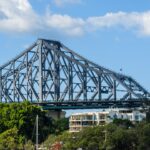
This article follows State Library of Queensland accounts of the Victoria Bridge, the 1893 flood and the Grey Street (William Jolly) Bridge, and adds detail from Brisbane City Council’s heritage material and Queensland Places. The Story Bridge has its own article, Story Bridge History, so it is not covered in depth here.
From a temporary bridge to the Victoria Bridge
A temporary wooden Brisbane Bridge was completed in 1865, built in timber because the council could not afford steel. It collapsed on 16 November 1867 after a high tide and a large coach put pressure on piles weakened by marine borers. A bridge named Victoria Bridge after Queen Victoria was completed in 1874.
Brisbane City Council says the first three bridges at this crossing were either ruined by marine wood borers or swept away in floods. Counting differs between sources: the State Library calls the bridge that opened in 1969 the third version, while Council describes the abutments of the 1890s bridge as remnants of the fourth bridge at the site. This article reports that difference without adopting either count, and refers to each bridge by its date.
The 1893 flood
In the February 1893 flood a section of the Victoria Bridge collapsed, and the State Library puts about 900mm of rain within a day on 5 February 1893. The Indooroopilly Railway Bridge, also called the Albert Bridge, was destroyed on 5 February. The State Library says the Brisbane River rose 7.2 metres above the mean spring tide, and that the Victoria Bridge and the Indooroopilly Railway Bridge were swept away. Queensland Places records that there were three flood events in February 1893, one of them 4.5 metres higher than the previous record.
The 1897 and 1969 Victoria Bridges
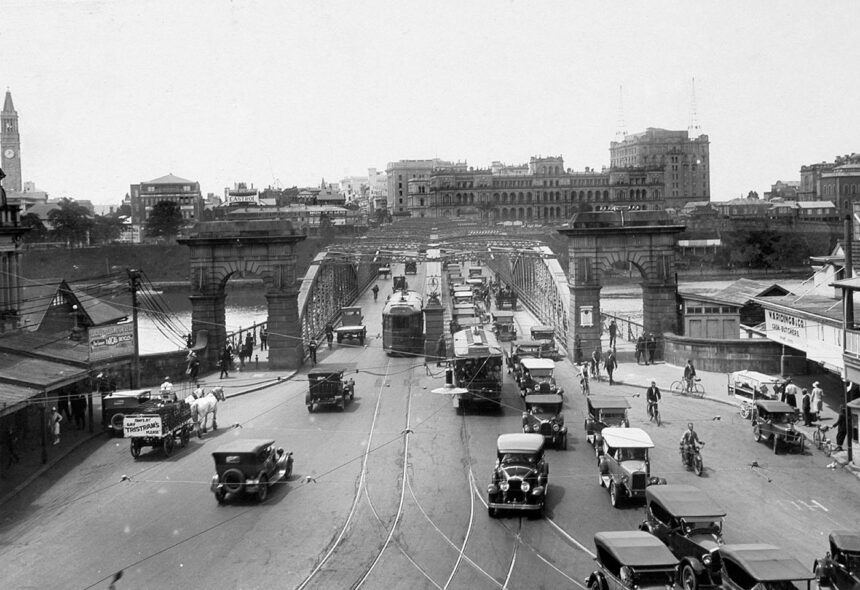
The Victoria Bridge that opened on 22 June 1897 was designed by Alfred Barton Brady. Council describes it as an iron bridge with arched abutments of Brisbane Tuff and neoclassical ornamentation at each end, constructed in 1896 to Brady’s design. Council notes that the opening may have been a shambolic affair, because The Week newspaper reported a wild rush for pieces of ribbon after it was cut. It adds that opening ceremonies on both sides of the river required back-and-forth processions by dignitaries.
Council says that until the 1930s the Victoria Bridge was the only permanent crossing between north and south Brisbane. The current bridge opened on 14 April 1969, and it has survived the 1974 and 2011 floods. When the 1897 bridge was demolished in 1969, portions of its Brisbane Tuff abutments were left in place to show its earlier form. Those Former Victoria Bridge Abutments were entered on the Queensland Heritage Register on 21 August 1992. A State Library account written with 2021 in mind says the bridge “will permanently close” to general car traffic on 24 January; it is a forward-looking statement, and this article does not confirm from a later source that the closure took place.
Grey Street Bridge
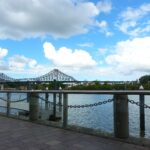
The Grey Street Bridge, now the William Jolly Bridge, opened on 30 March 1932. Council says it was built after the greater City of Brisbane formed in 1925, and that it has three major spans with arched ribs rising through the deck. Engineer Alison Eavis Harding Frew designed the bridge, and M. R. Hornibrook Ltd began construction in August 1928 after a winning tender of 384,850 pounds; the total cost was 674,526 pounds. Manuel Hornibrook designed the sand-island method used to sink its pylons.
Council reports that the bridge was hailed at the time as the largest reinforced concrete bridge in the Southern Hemisphere and one of the largest in the world. Evans Deakin & Co Ltd fabricated the steelwork, which was encased in gunite, a sprayed dry-mix concrete. In July 1930 construction halted after a fire began 100 feet (30.48 metres) below the river surface in one of the bridge airlocks, and the workmen reached safety.
Governor Sir John Goodwin officially opened the bridge on 30 March 1932, 11 days after the Sydney Harbour Bridge opened. A huge crowd attended, some people climbed the arches for a better view, and the event was described over the radio on station 4QG. The bridge was renamed in 1955 after William Jolly, the first Lord Mayor of the Greater Brisbane City Council. Queensland Places adds that Jolly, a former mayor of Windsor, was elected Lord Mayor of the new metropolis-wide city, whose Council set cross-river bridge building in train. The William Jolly Bridge was entered on the Queensland Heritage Register on 6 August 1996.
Later crossings
Council says the Walter Taylor Bridge followed the Victoria Bridge and the Grey Street Bridge in 1936. Queensland Places lists the Story Bridge as opening in 1940 and tolled until 1947, the Indooroopilly Bridge as opening in 1936 and tolled until 1965, and the Captain Cook Bridge as opening in 1972. It dates the Gateway Bridge to 1985 and the pedestrian and cycle Goodwill Bridge to 2001. This article gives those dates as listed and does not describe those later bridges further.
Frequently asked questions
When did part of the Victoria Bridge collapse in the 1893 flood?
The State Library of Queensland records a section collapsing in the February 1893 flood, and places about 900mm of rain within a day on 5 February 1893; it does not give a separate collapse date in the account used here.
What was the William Jolly Bridge originally called?
It opened as the Grey Street Bridge in 1932 and was renamed in 1955.
Which other bridge was lost in the 1893 flood?
The Indooroopilly Railway Bridge, also called the Albert Bridge, was destroyed on 5 February 1893.
Who designed the William Jolly Bridge?
Brisbane City Council’s heritage trail names engineer Alison Eavis Harding Frew as its designer, with M. R. Hornibrook Ltd beginning construction in August 1928.