
This article follows the New Farm Powerhouse from a 1928 tram power station to a cultural and performing arts venue. It draws on a Brisbane City Council heritage citation, the venue’s own history page and the New Farm and Districts Historical Society, and names the source for each claim. It covers history only.
Land, a council and a power station
The historical society places the powerhouse in the early years of the Greater Brisbane Council. It calls it Brisbane’s first local government power station and an early project of the “Jolly Council”, the first council of Greater Brisbane, built on land Brisbane Council had bought in 1915 for a park. The society says the new council resumed part of New Farm Park in 1926 for a powerhouse, and that building took from 1926 to 1930, together with nine substations. Council’s citation says the architect also designed eight Tramways substations. The counts are not the same, and this article does not reconcile them.
A power station for the trams
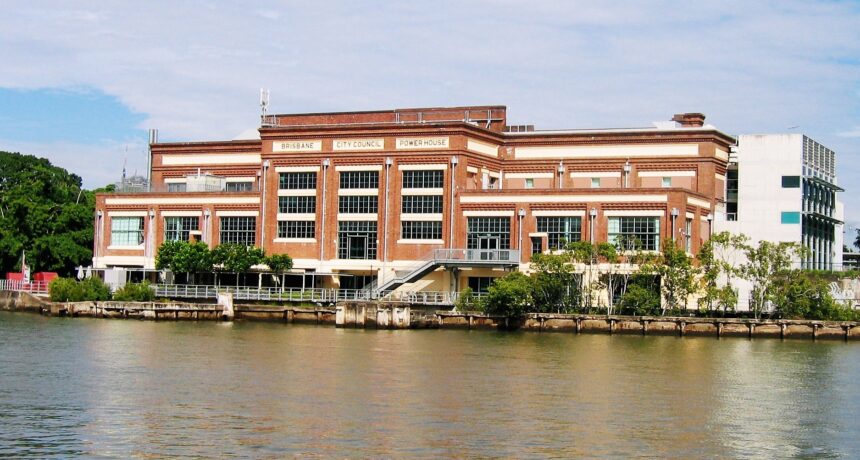
Council’s heritage citation says the New Farm Powerhouse was built in 1928 to provide power for Brisbane’s expanding tram network. It names Roy Rusden Ogg, architect for the Brisbane City Council’s Tramways Department, as the designer. The historical society describes it as an elegant Modernist industrial structure and says it began operations in 1928, producing electricity from coal transported by rail. The venue’s history page adds that coal arrived by river and train and was burned in a boiler to make the steam that ran the turbine, and that the station generated power and lighting for the suburbs of Toowong, Ithaca and Yeerongpilly.
The citation says the building went up in two stages as demand for power grew, the first comprising the turbine room and boiler house. The first section of the stores building followed in 1929. In 1934 the turbine room was extended, the switch house facing the river was built and the stores building was extended. A further boiler house bay and a staff accommodation wing came in 1936, and a major and final boiler house extension was completed in 1940. After the Second World War the powerhouse operated at peak capacity, according to the citation.
Change of ownership and closure
Council’s citation says operations passed to the Southern Electric Authority in 1963, and the historical society likewise says the Authority acquired the powerhouse from the Council in that year. The citation adds that the Authority later became the South East Queensland Electricity Board.
Sources describe the 1971 closure in different terms. Council’s citation says the powerhouse was decommissioned in 1971 when it was superseded by the Swanbank Power Station. The venue’s history page says the tramway was decommissioned in 1971, beginning the spiral into dereliction. The historical society says Swanbank Powerhouse came online in 1971 and led to the closure of New Farm Powerhouse, and it gives no exact closure date. It also says the plant was in decline by 1969 with maintenance issues looming, and that serious structural concerns lay behind the closure. This article does not choose between these wordings.
The citation says the electricity board kept using the site as a works depot, and that generating plant and ancillary structures were removed in the late 1970s. The historical society says the building was later used as an Army training ground and a store for dangerous chemicals, until local residents’ opposition led the State Government to abandon the storage. Council’s citation says fears about the security and stability of the boiler house section led to its partial demolition in 1984.
Dereliction and graffiti
The citation says the structure suffered neglect and vandalism and was occasionally used for dramatic theatre and rave events. The venue’s history page says squatters and artists made their home among the industrial structures and left graffiti that is now officially known as heritage-listed aerosol art. The historical society says street kids frequented the derelict building and that the late-1990s redevelopment kept their graffiti as part of the building’s history and character.
Back to Council hands and the arts
The venue’s history page says Brisbane City Council reacquired the building in 1989. The historical society says the Council bought it back from the Queensland Electricity Commission, while the citation says most of the site was transferred to the Council that year. The citation says the Urban Renewal Task Force recommended in 1991 that the feasibility of keeping the building for public or residential purposes be reviewed, and that the Council then initiated its development into a cultural and performing arts venue. It says the brief was shaped by extensive public consultation and the Task Force’s direction, and that a team of City Design (theatres), Cox Rayner (urban design) and Allom Lovell (conservation) developed the design.
The two main sources give different opening points. The venue’s history page says New Farm Powerhouse finally opened to the public in 1994, in an event called Transplant that broke a 23-year art drought. It also says the redeveloped venue, designed by Council architect Peter Roy, was opened on 10 May 2000 by Lord Mayor Jim Soorley. Council’s citation says construction commenced early in 1999 and the complex was completed in 2000, and records the place as a Local Heritage Place from 30 October 2000.
What the building keeps of its past
The citation, dated June 2001, describes the demolished boiler room’s site as a large entry plaza. It lists the place’s significance as including evidence of the scale of the former Tramways network, and calls it an important landmark on the New Farm peninsula, visible from the Humbug and Bulimba Reaches of the river.
The venue’s history page says the building was re-opened on 6 June 2007 by Lord Mayor Campbell Newman after a further stage of development, aimed at increasing audience capacities and restaurant, bar, function and conference spaces.
Related reading
The powerhouse was built to serve the tram network; see Brisbane Trams: History of the Tram Network. The wider story of the waterway is in The History of the Brisbane River, the park beside it in the New Farm Park Guide, and similar buildings in the Brisbane Heritage-Listed Buildings Guide.
*Sources were read on 9 November 2026.*
Frequently asked questions
When was the Brisbane Powerhouse built?
Council’s heritage citation says the New Farm Powerhouse was built in 1928 to provide power for Brisbane’s expanding tram network. The historical society says building took from 1926 to 1930 together with nine substations.
Who designed the New Farm Powerhouse?
Council’s citation names Roy Rusden Ogg, architect for the Brisbane City Council’s Tramways Department.
Why did the New Farm Powerhouse close?
Council’s citation says it was decommissioned in 1971 when superseded by the Swanbank Power Station. The historical society says Swanbank came online in 1971 and led to the closure, citing serious structural concerns.
When did the Brisbane Powerhouse become an arts venue?
The venue says it finally opened to the public in 1994 and that the redeveloped venue was opened on 10 May 2000; Council’s citation says the complex was completed in 2000.