
Brisbane began as a place of punishment
Before Brisbane was a city, it was a penal settlement. Moreton Bay was set up in 1824 as a place of secondary punishment, meaning a site for convicts who had already re-offended. The State Library of Queensland describes it as a place to house hardened criminals and recidivist prisoners. In 1824 the Governor of New South Wales, Sir Thomas Brisbane, gave the instructions to establish it.
Redcliffe first, then the river
The settlement did not begin where the CBD now stands. Lieutenant Henry Miller and his party landed at Redcliffe from the brig Amity in September 1824. The site was hard to supply and its farming conditions were less favourable than expected. The settlement was abandoned and relocated to the Brisbane River in 1825.
Who ran it, and who lived there
Miller was the first commandant, serving from 1824 to 1825. Captain Patrick Logan of the 57th Regiment held command from 1826 to 1830. Soldier detachments of up to 100 guarded the depots.
The State Library records that nearly 2,400 men and 145 women lived at depots stretching from Stradbroke Island to Limestone (Ipswich). Those depots included Cowper’s Plains and Eagle Farm. Brisbane Town was one place among several, not the whole settlement.
How it ended
In 1839 the costly settlement was effectively closed and the bulk of the convict population was removed. The Archives date the formal end to 1842, when the Moreton Bay area was opened to free settlement.
The records that survive
In 1828 Peter Beauclerk Spicer, the superintendent of convicts at Brisbane Town, compiled a journal of the settlement. Its register of daily public labour by Crown prisoners covers 26 May to 15 September 1828. Queensland State Archives notes that its convict-era records, which include material of this kind, were listed by UNESCO in 2012.
Convict-era places you can still visit
The Old Windmill, Wickham Terrace
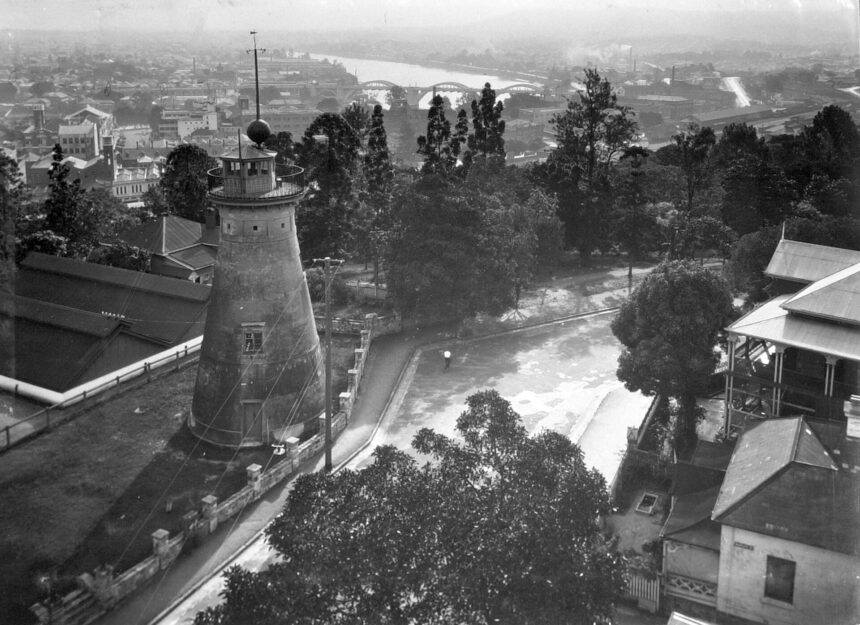
Museum of Brisbane says the Windmill was built in 1828 to grind local corn and wheat. As many as 25 convicts worked its treadmill for up to 14 hours at a time, wearing leg irons. The museum states that the treadmill and gallows were gone by October 1849.
Museum of Brisbane records that two Aboriginal men, Mullan and Ningavil, were hanged from it. Queensland Museum notes that the treadmill wheel was struck by lightning in 1836 and that the building was later converted to a signal station. It also calls the mill Queensland’s oldest building.
The Commissariat Store, William Street
The Commissariat procured, stored and distributed provisions to the military, convicts and colonists. Its stone store was commissioned by Commandant Logan and completed in 1829. The tuff blocks came from the cliffs at Kangaroo Point.
After the penal era the building served as a land sales office and immigrant depot, gained an extra storey in 1913 and became the Royal Historical Society of Queensland’s headquarters in 1981. As at November 2026, the society’s leaflet lists a museum open Tuesday to Friday, 10am to 4pm, closed public holidays; check before you go.
Seeing both on one walk
As listed on its tour page in November 2026, Museum of Brisbane runs a Convict Brisbane Walking Tour from the Windmill to the Commissariat Store at Queens Wharf Road, though it does not go inside the Windmill.
What this guide leaves out
Sources differ on some details, such as the exact day of the Redcliffe landing, so this article gives months and years only. Convict population totals also vary between sources, so only the State Library’s figure of nearly 2,400 men and 145 women is quoted.
Frequently asked questions
When was Brisbane a penal settlement?
Moreton Bay was established as a penal settlement in 1824, effectively closed in 1839 and formally ended in 1842 when the area opened to free settlement.
Where was the first Moreton Bay settlement?
At Redcliffe in September 1824; it was relocated to the Brisbane River in 1825.
What convict-era buildings survive in Brisbane?
The Old Windmill on Wickham Terrace (built 1828) and the Commissariat Store on William Street (completed 1829).