





This guide pulls together what Translink and Queensland Rail say on their own pages about wheelchair, mobility scooter and pram travel on Brisbane’s public transport. Each statement is attributed to its source and dated in the sentence. It carries no fares.
Start with the rules for mobility devices
At 9 November 2026, per Translink’s accessible services page, most of its vehicles are accessible, with allocated spaces for wheelchairs and mobility scooters on new buses and on all trains, trams and ferries, and Translink recommends contacting its delivery partner before a journey. At 9 November 2026, per the same page, Translink says a wheelchair or mobility scooter must meet the size, height, weight and manoeuvrability criteria in the Disability Standards for Accessible Public Transport 2002.
Buses and busways
At 9 November 2026, per Translink, new accessible buses have low floor entry, a ramp and an allocated space for wheelchairs and mobility scooters. For Brisbane Metro, Translink says at 9 November 2026 that the mobility bays are in the first compartment and that boarding starts with the blue ramp request button on the left side of the first compartment door. At 9 November 2026, per Translink, busway stations have lifts, ramps and pathways, are fully accessible, and have tactile ground surface indicators for customers with vision impairment.
Trains and stations
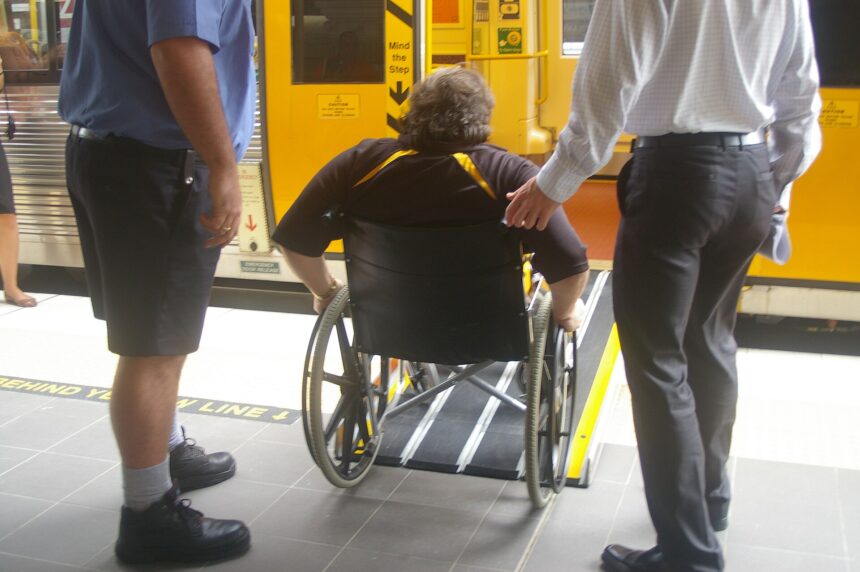
At 9 November 2026, per Translink, wheelchairs and mobility scooters can be taken on all of its train services, with allocated spaces in the middle carriage. Translink says at 9 November 2026 that the assisted boarding point is marked with the international symbol for access, sits in the middle of the platform, and is where staff deploy a ramp. For more on how the network runs, see Brisbane Trains Explained.
At 9 November 2026, per Translink, the level of access varies across the train network and many stations can be reached by lifts and ramps. Queensland Rail says at 9 November 2026 that its Your Station pages show information about the platform step and gap at each station.
Assisted boarding on Queensland Rail
At 9 November 2026, per Queensland Rail, assisted boarding is available on request, with staff placing a ramp between the platform and the train floor. For safety, Queensland Rail says at 9 November 2026 that a mobility device cannot be over 750mm wide by 1300mm long, and the combined weight of the user, the device and anything carried must be under 300kg. It says at 9 November 2026 that motorised mobility device users need to use the ramp unaided, and that a manual wheelchair needing staff help must have handles. At 9 November 2026, according to Queensland Rail, staff cannot help with operating or moving a mobility device, including lifting, pushing or carrying, or with personal care needs.

Where a station has a core safety zone, Queensland Rail says at 9 November 2026 that it is generally in the middle of the platform and shown by blue and white striped lines, with an emergency help phone. At 9 November 2026, per Queensland Rail, at an unattended station a customer should go to the assisted boarding point, where onboard staff will assist with boarding. Calling ahead on 13 16 17 (7.15am to 5pm AEST, Monday to Friday) or texting 0428 774 636 (text only) is optional, according to Queensland Rail at 9 November 2026. Per Queensland Rail at 9 November 2026, its text message service is available 24/7 and can be used to book assisted boarding.
On board
At 9 November 2026, per Queensland Rail, allocated spaces for wheelchairs and mobility devices are in every train, identified by external signage on the carriage and floor decals inside. Queensland Rail says at 9 November 2026 that it has eight different types of trains and that the type running a given service cannot currently be found out ahead of time. Onboard bathrooms vary: at 9 November 2026, per Queensland Rail, NGR and IMU trains have at least one unisex bathroom, while SMU and EMU trains do not. At 9 November 2026, per Translink, priority seating near the door in every carriage is for people with a disability, older adults, people who are pregnant, people with an injury and people travelling with young children.
Ferries, trams and taxis
At 9 November 2026, per Translink, all CityCat ferries are fully accessible, with four wheelchair and mobility scooter spaces on each vessel, while Cross River Ferry services are not accessible. Translink adds at 9 November 2026 that many CityCat terminals are fully accessible and that the ferry network map shows which ones. At 9 November 2026, per Translink, all Bay Island Transit ferry services have two allocated spaces for wheelchairs and mobility scooters. The Brisbane CityCats and Ferries Guide covers the services themselves.
On the Gold Coast, Translink says at 9 November 2026 that all G:link tram services can carry wheelchairs and mobility scooters, with an allocated space towards the front and rear of the tram. At 9 November 2026, per Translink, each platform has two bright blue boarding assistance points marked with the universal wheelchair symbol.



At 9 November 2026, per Translink, accessible taxis can carry wheelchairs and mobility scooters, mobility scooter users must relocate to a fixed seat, and accessible taxis operate in all cities and some towns.
Travelling with a pram or stroller
At 9 November 2026, per Translink’s travel tips page, a pram or stroller may need to be folded and stored in the luggage rack during busy morning and afternoon times, when the driver advises there is not enough space, on a bus that is not wheelchair accessible, or when the wheelchair space is occupied or required. At all other times, Translink says at 9 November 2026, a child can travel seated in the pram or stroller. At 9 November 2026, per Translink, pram users are asked to park in the designated wheelchair space with the brake on, secure the child in the harness and hold on to the pram. Translink says at 9 November 2026 that its staff are not required to assist in folding and loading prams or other large objects.
At 9 November 2026, per its Station Accessibility Upgrade Program page, Queensland Rail describes the program as designed to benefit customers including those using mobility devices and those travelling with prams and luggage. For walking routes see Pram-Friendly Walks in Brisbane, for the wider family picture see Kids and Public Transport in Brisbane: A Parents Guide, and for play spaces see Accessible and Inclusive Playgrounds in Brisbane.
Frequently asked questions
Can I take a mobility scooter on Brisbane trains?
At 9 November 2026, Translink says wheelchairs and mobility scooters can be taken on all of its train services, with allocated spaces in the middle carriage. At 9 November 2026, Queensland Rail says a device cannot be over 750mm wide by 1300mm long and the combined weight must be under 300kg.
Do I need to book assisted boarding on a train?
Queensland Rail says calling or texting ahead is optional, using 13 16 17 (7.15am to 5pm AEST, Monday to Friday) or 0428 774 636 (text only), as at 9 November 2026. At 9 November 2026, it also says that at an unattended station customers go to the assisted boarding point and onboard staff will assist with boarding.
Can a pram stay open on a bus?
At 9 November 2026, Translink says that at times other than those it lists, a child can travel seated in the pram or stroller. At 9 November 2026, it lists busy morning and afternoon times and a driver’s advice that there is not enough space among the situations when a pram may need folding.
Are all Brisbane ferries wheelchair accessible?
At 9 November 2026, Translink says all CityCat ferries are fully accessible, while Cross River Ferry services are not accessible.