




This guide explains the migration pattern, how to watch from land or water, and the approach rules, using Queensland Government pages. It leaves out operator prices and timetables, which change.
When the humpbacks pass by
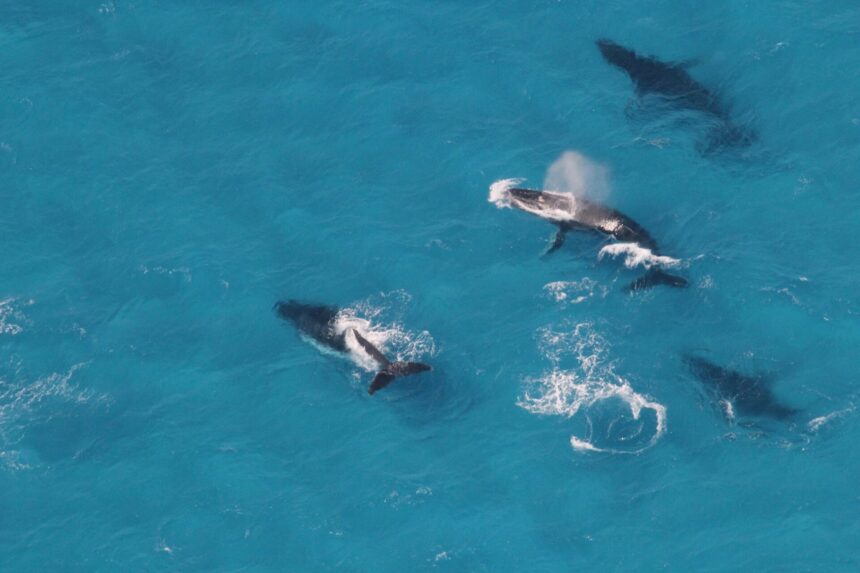
At 9 November 2026, the Queensland Government’s whale-watching page (last updated 31 October 2024) says humpbacks generally migrate northwards along the coast between May and July. After time in tropical breeding grounds they turn south in July and August. Queensland’s waters matter for the species: the government describes them as critical for mating and giving birth. The southward trip also brings a chance of seeing mothers with newborn calves.
One caution about place. The same page describes the Queensland coast as a whole. It gives a separate window of August to October for Hervey Bay, where about a quarter of the population enters the bay on the southward migration, and that window applies to Hervey Bay rather than Brisbane. The Moreton Bay Marine Park pages that would give bay-specific detail could not be read for this guide, so it states no Moreton Bay dates.
Watching from land
You do not need a boat. The government says migrating humpbacks can be seen from vantage points such as headlands and even open beaches in some areas, with binoculars or spotting scopes helping. It also says calm conditions are best, most likely in the morning before wind picks up, and that late-afternoon light from a headland can make breaches and blows spectacular.
Giving whales space
The government’s central message is to give the animal room to behave naturally. On the water the chance of seeing whales is much greater, but so is the risk of boats disturbing them or separating mothers from calves. A whale that feels disturbed spends less time at the surface and is more likely to leave the area. Signs of disturbance include a whale that moves away from a boat or regularly changes swimming speed or direction. At the first sign, the page says to move your boat away.
The approach rules
At 9 November 2026, the Queensland Government’s rules page (updated 5 March 2026) explains approach distances in two layers. It says they apply to boats, including kayaks and paddle boards, as well as jet skis, aircraft, drones, helicopters and people in the water.
- Caution zone: boats cannot travel faster than 6 knots within 300 metres of a whale.
- No approach zone: for a whale, this surrounds the animal for 100 metres and extends 300 metres in front of and behind it.
- Three-boat rule: a boat cannot enter a caution zone if three boats are already in it.
- Jet skis and aircraft: not within 300 metres of a whale.
- Drones: not within 100 metres. Helicopters: not within 500 metres, with no hovering above a marine mammal.
- People in the water: not within 100 metres of a whale.
- Migaloo and other humpbacks that are more than 90% white: boats and jet skis cannot approach within 500 metres, and aircraft within 610 metres.
If a whale approaches your boat, the rules still apply. Inside a caution zone you must not exceed 6 knots. Inside a no approach zone the operator must turn the engines off or disengage the gears, or withdraw at a speed below 6 knots. The government also asks boaters never to restrict a whale’s path or drive into a pod, and not to make a loud or sudden noise near, touch or feed a marine mammal. It adds that penalties apply, and it points out that a fully grown humpback weighs up to 45 tonnes.
If you find a stranded whale
At 9 November 2026, the Queensland Government’s whale-watching page says to report a stranded whale, alive or dead, using the free QWildlife app or by calling 1300 130 372 (press option 1). While you wait for experts, the page says “keep away from the head and tail” and “avoid touching the whale”. It also says: “Do not try to push the whale back into the water as this will add to its suffering”. It asks you to “ensure that dogs and small children are kept well away from the whale”.
Frequently asked questions
When do humpback whales migrate along the Queensland coast?
At 9 November 2026, the Queensland Government says generally north between May and July, turning south in July and August (page last updated 31 October 2024).
How close can a boat go to a whale?
At 9 November 2026, the rules page (updated 5 March 2026) sets a 300 metre caution zone with a 6 knot limit, and a no approach zone of 100 metres around the whale and 300 metres in front and behind.

Can I watch whales without a boat?
Yes. The government says migrating humpbacks can be seen from headlands and even open beaches in some areas.
What should I do about a stranded whale?
At 9 November 2026, the Queensland Government says to report it via the QWildlife app or on 1300 130 372 (press option 1), and to “keep away from the head and tail”.