
This guide explains how the bus network is described by TransLink and Brisbane City Council, how to read route numbers and stops, and which accessibility features each source lists. Every rule or name below is dated to 9 November 2026 and attributed to its source. The guide deliberately leaves out timetables, fares and temporary changes.
Who does what
At 9 November 2026, TransLink lists buses as running across its entire network, per its bus, train, ferry and tram page. At 9 November 2026, Brisbane City Council’s buses page points readers to TransLink for timetables and ticketing information. At 9 November 2026, Council says its bus depots provide onsite maintenance, cleaning and refuelling, scheduling and rostering, and driver amenities. At 9 November 2026, Council’s bus page describes a current fleet of more than 1,200 buses and a growing fleet of metro vehicles.
Reading route numbers
At 9 November 2026, TransLink’s journey planning help says most buses have a 2- or 3-digit route number. At 9 November 2026, the same page says some services have a letter as well, with ‘P’ for prepaid services, ‘R’ for railbus services and ‘N’ for Nightlink given as examples. At 9 November 2026, the same page says the journey planner lets people choose between regular, express, Nightlink or school bus service types. At 9 November 2026, TransLink gives the example that Nightlink buses only operate on Friday and Saturday nights.
At 9 November 2026, Council says it developed a network of ‘no timetable needed’ high-frequency bus services known as Bus Upgrade Zone, or BUZ, services. At 9 November 2026, Council’s BUZ table lists route 100 as serving Forest Lake and the city via Ipswich Road and route 385 as serving The Gap and the city.
Service types by name
At 9 November 2026, TransLink describes CityGlider as a high-frequency bus service that operates throughout the day. At 9 November 2026, Council says the Blue CityGlider, route 60, travels from West End to the west of the CBD to Newstead in the east. At 9 November 2026, Council says the Maroon CityGlider, route 61, operates from Ashgrove to Coorparoo.
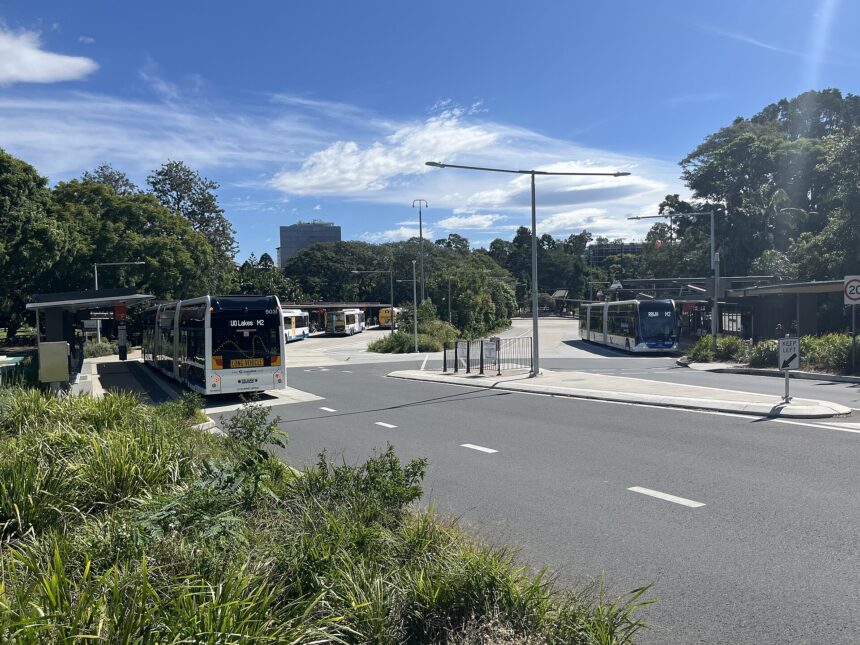
At 9 November 2026, Council describes Brisbane Metro as a high-capacity, high-frequency bus rapid transit system. At 9 November 2026, Council says metros avoid the need for tracks and overhead line equipment by travelling on the existing busway infrastructure. At 9 November 2026, Council lists the M1 route as Eight Mile Plains to Roma Street and the M2 route as UQ Lakes to the Royal Brisbane and Women’s Hospital. At 9 November 2026, Council’s Metro page says that in 2025 it launched those two routes alongside a new bus network.

At 9 November 2026, Council lists the Spring Hill Loop as route 30, served by yellow signposted bus stops. At 9 November 2026, Council lists the City Loop as routes 40 and 50, served by purple signposted bus stops. At 9 November 2026, TransLink describes route 40 as clockwise and route 50 as anti-clockwise. At 9 November 2026, TransLink describes flexible local transport as a flexible, shared and pre-booked service that connects riders to the wider network in some areas.
Reading stops and signs
At 9 November 2026, TransLink says each stop has a name and a 6-digit stop ID, which can be found online or on the printed timetable at each bus stop. At 9 November 2026, TransLink says stop timetables can also be reached through the QR code on the printed stop timetable or the NFC reader fitted on most bus stop poles. At 9 November 2026, TransLink points riders to its app for real-time information, journey planning and service notice information. For how alerts are worded, see How to Read TransLink Service Alerts.
At 9 November 2026, TransLink’s travel tips say to raise your hand to signal the driver when you want to catch a bus. At 9 November 2026, the same page says to press the stop button at least 100 metres before your stop. Ticketing is covered in Go Card and Public Transport Tickets Explained.
Accessibility features
The two sources word fleet accessibility differently, and both are attributed here without being reconciled. At 9 November 2026, TransLink says most buses on its network are accessible, with older buses replaced by new accessible buses as they are retired. At 9 November 2026, TransLink says those new buses have low floor entry, a ramp and allocated space for wheelchairs and mobility scooters. At 9 November 2026, Council says its fleet is 100% air conditioned and accessible. At 9 November 2026, TransLink recommends contacting its delivery partner before the journey to ensure an allocated space is available.
At 9 November 2026, Council lists Brisbane Metro vehicle features including USB charging stations, onboard Wi-Fi, audio and hearing loops, low-floor design, mobility bays and dynamic route displays. At 9 November 2026, TransLink says that to board a metro you press the blue ramp request button on the left side of the first compartment door.
At 9 November 2026, TransLink says busway stations are equipped with lifts, ramps and pathways and are fully accessible, and that they have tactile ground surface indicators to assist customers with vision impairment. At 9 November 2026, a TransLink projects page that refers to 2020-21 describes small blue metal plates with Braille, tactile and QR code stop numbers added to select inner-city bus stops and bus stations, and says that in 2020-21 TransLink was looking at extending them further outside inner city locations. For prams, see Kids and Public Transport in Brisbane: A Parents Guide. At 9 November 2026, TransLink says that, for example, a pram or stroller may need to be folded and stored in the luggage rack when travelling during busy morning and afternoon times, which is one of the conditions its page lists. For trains and ferries, see Brisbane Trains Explained and Brisbane CityCats and Ferries Guide.
Frequently asked questions
What do the letters on some Brisbane bus route numbers mean?
At 9 November 2026, TransLink says some services carry a letter such as ‘P’ for prepaid services, ‘R’ for railbus services or ‘N’ for Nightlink.
How do I find a timetable for one bus stop?
At 9 November 2026, TransLink says each stop has a name and 6-digit stop ID that can be entered into its journey planner for stop-specific timetables.
Are all Brisbane buses accessible?
At 9 November 2026 the sources word this differently: TransLink says most buses on its network are accessible, while Council says its fleet is 100% air conditioned and accessible.
How do I ask the driver to stop?
At 9 November 2026, TransLink says to press the stop button at least 100 metres before your stop.