

The name Moreton Bay bug appears in fisheries reports and in recreational fishing rules, and it covers more than one animal. This guide sticks to what Queensland Government and national fisheries documents say about the animal, how it is caught and how it is managed. It does not recommend venues or discuss prices.
What the name covers
The Status of Australian Fish Stocks (SAFS) report on Moreton Bay Bugs, published in June 2023, says Reef Bug (Thenus australiensis) and Mud Bug (Thenus parindicus) are known collectively as Moreton Bay Bugs. The same report gives their range as the tropical and subtropical coast of Australia from northern New South Wales to Shark Bay in Western Australia.
According to the report, the two species have overlapping distributions but display relatively strong habitat partitioning: Reef Bugs typically prefer deeper areas with coarser sediments, while Mud Bugs inhabit mainly shallow inshore areas with finer sediments. Its biology table lists a longevity of 7 years for Moreton Bay Bugs, and the report refers to an approximately 45-day pelagic larval phase.
How they are caught
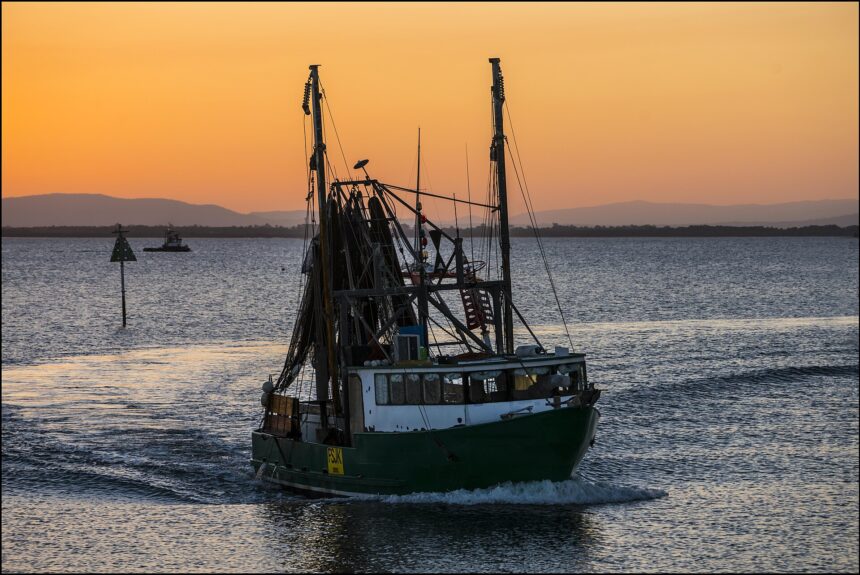
A 2020 Fisheries Queensland catch-rate report describes Moreton Bay bugs as a valuable product of Queensland’s prawn and scallop trawl fisheries. It says they are taken mainly by trawl along the Queensland coast, in depths less than 80 m.
The 2023 SAFS report says around 80% of total landings occur in the Queensland East Coast Otter Trawl Fishery (ECOTF). It describes that fishery as one fleet north of 22 degrees south trawling for prawns and one fleet south of 22 degrees south trawling for scallops. It also says two areas, Hervey Bay-Gladstone and Townsville, contribute approximately 80% of Moreton Bay Bug landings in the ECOTF.
The 2020 Fisheries Queensland report says Moreton Bay bug were previously caught incidentally when other species were being targeted. The SAFS report, citing McMillan and colleagues (2023), says modelling indicated Reef Bugs rose from around 67% of ECOTF landings in 1988 to 93% in 2021, while Mud Bugs remain an incidentally caught species in that fishery. It also says that, because of depletion of the Saucer Scallop stock and closure of that fishery since 2021 in the Hervey Bay-Gladstone region, the southern fleet has shifted to increased targeting of co-located Reef Bugs.
How stocks are assessed and managed
The SAFS report says the first stock assessment of Moreton Bay Bugs in the ECOTF estimated that in 2021 the Reef Bug stock was at approximately 78% of unfished biomass. It says the Mud Bug stock was not assessed due to uncertainties assessing non-target species. On the evidence it sets out, the report classifies the East Coast Otter Trawl Fishery management unit as a sustainable stock.
The report also quotes standardised Reef Bug catch rates, citing McMillan and colleagues (2023): they rose from 35 kg/day in 1988 to a peak of 46 kg/day in 2013 and stabilised at 36 kg/day by 2021.
Two gear and size points appear in the same report. It says square-mesh cod end bycatch reduction devices were made mandatory in the Scallop Fishery in 2015, allowing juvenile Moreton Bay Bugs to escape trawl capture. It also says that, based on yield-per-recruit analysis, capture at 75 mm carapace width or more allows Moreton Bay Bugs to spawn before they enter the fishery.
Recreational rules at a glance
At 10 November 2026, the tidal-waters size and possession limits page (last updated 25 September 2026) lists Moreton Bay bug (bay lobster) with a minimum size of 7.5 cm across the widest part of the shell and a limit of 20.

At 10 November 2026, the same page (last updated 25 September 2026) says you cannot have bug meat in your possession on a boat unless you intend to eat it immediately, otherwise bugs must remain whole. At 10 November 2026, it adds that you cannot have a bug with a damaged shell or with a shell separated from the body in your possession.
At 10 November 2026, the page (last updated 25 September 2026) lists Balmain (smooth) bug as a separate entry, with a minimum of 10.5 cm across the widest part of the shell and a limit of 20.
Related reading
For the wider story of the bay itself, see History of Moreton Bay. For places to visit on and around the water, see the Moreton Island Day Trip Guide and the Wynnum and Manly Foreshore Guide.
Frequently asked questions
Is a Moreton Bay bug one species?
At 10 November 2026, the SAFS report published in June 2023 says the name is used collectively for two species, Reef Bug and Mud Bug.
How are Moreton Bay bugs mostly caught?
At 10 November 2026, a Fisheries Queensland report from 2020 says they are taken mainly by trawl along the Queensland coast, and the 2023 SAFS report says around 80% of total landings occur in the Queensland East Coast Otter Trawl Fishery.
What is the recreational minimum size for a Moreton Bay bug?
At 10 November 2026, the Queensland Government tidal-waters page (last updated 25 September 2026) lists a minimum of 7.5 cm across the widest part of the shell and a limit of 20.