
This guide covers four parks and describes each one using only what Brisbane City Council publishes, either on its park pages or in its local heritage records. Parks that already have their own guides on this site, such as Roma Street Parkland, New Farm Park, Sherwood Arboretum and Karawatha Forest Park, are linked at the end rather than repeated.
Starting points for exploring council parks
At 9 November 2026, the council’s parks and greenspaces page invites people to explore parks in Brisbane and see what they have to offer. At the same date, it describes park facilities as ranging from off-leash dog areas to barbecues and outdoor gyms.
City Botanic Gardens, Brisbane City
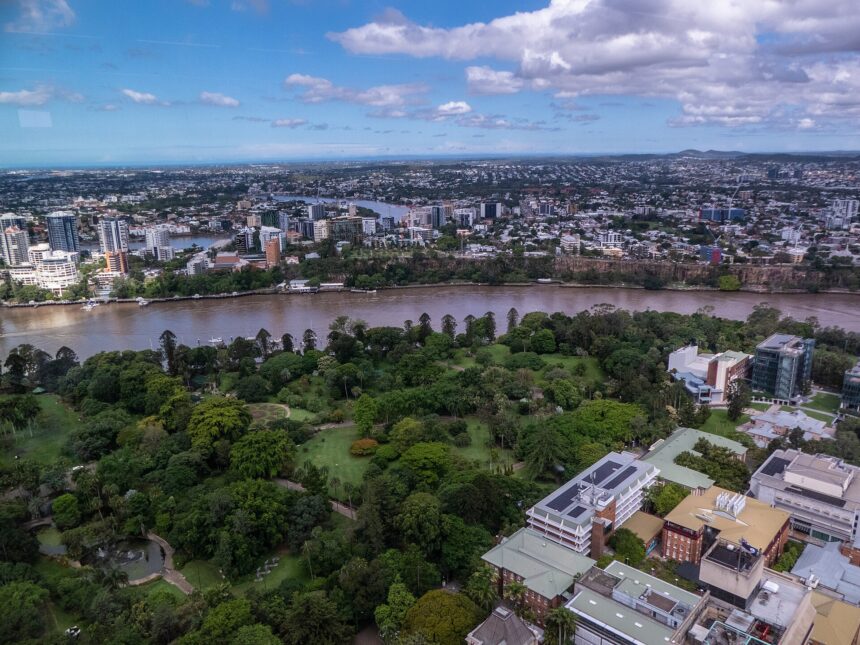
At 9 November 2026, the council describes the City Botanic Gardens as Queensland’s oldest heritage garden. At the same date, it says the riverside park spans 18 hectares and 1.2 kilometres of river frontage, and that it is home to heritage, exotic and native plants and trees. At 9 November 2026, the council lists the address as 147 Alice Street, Brisbane City, and says the gardens are open 24 hours, 7 days a week. At the same date, its page adds that facilities and services, such as the cafe and information kiosk, have individual operating hours.
At 9 November 2026, the council describes an hour-long guided walk led by a local, covering the gardens’ history and features. At that date, it says self-guided walkers can collect a Treasures brochure at the Visitor Information Kiosk. The council also lists an accessible and inclusive playground, picnic shelters and toilets, including accessible toilets, as available at the gardens, as at 9 November 2026. At the same date, its page says the dog-friendly café sits inside the heritage-listed Curators Cottage.
Musgrave Park, South Brisbane
Council’s heritage record says Musgrave Park was gazetted in 1865 and is one of the oldest public parks in Brisbane. The record adds that, according to traditional history, the Indigenous peoples of the region used the area as a neutral gathering space. The record says the reserve stabilised at approximately 9.3 hectares bounded by Russell, Cordelia, Vulture and Edmondstone Streets.
The park also carries a sporting story. The heritage record says the South Brisbane Bowls Club was established in 1901. The same record says the club ceased operating in 1987 and the building has been adaptively re-used, now serving as an Aboriginal Community Centre, as the record read at 9 November 2026. It states that the Musgrave Park Pool was opened by Brisbane City Council in 1967. The council’s heritage record titled “Musgrave Park & South Brisbane Bowls Club (former)” gives “Local Heritage Place Since” as 30 October 2000, at 9 November 2026.
Davies Park, West End
The council’s heritage record says Davies Park was gazetted by the South Brisbane Municipal Council in 1901, and became the responsibility of Brisbane City Council after the amalgamations of 1925. It records that the reserve was renamed Davies Park in October 1909 in honour of John Davies. Extra land bought in 1919 was used for public baths that, according to the record, operated from 1920 to 1967.
Some of the park’s features are described in the same record. A gas stripping tower belonging to the South Brisbane Gas and Light Company was added to the riverfront promenade in 1979. The record calls the row of mature Moreton Bay Figs along Montague Road striking. It also says, as it read at 9 November 2026, that the largest oval, the Bill Tyquin Oval, is the home ground for Souths Rugby League Club.
Orleigh Park, West End
According to the heritage record, the land that is now Orleigh Park was acquired by the City of South Brisbane in 1916. The record says devastating floods in 1893 washed away almost every house on the Orleigh Estate. It also records another chapter: in 1900 a house called Cranbrook became a home for Aboriginal girls and young women who had been forcibly removed from their families and communities by the government. A set of concrete steps running down toward the river are the only remnants left of that house, the record says. It adds that in 1998 a plaque was installed recognising the land’s connection with the “Stolen Generation”.
The record says the South Brisbane Sailing Club erected its headquarters in the park in 1954 on land leased from the Council, and the Brisbane and GPS Rowing Club opened a new boatshed within the park in 1977. At 9 November 2026, the record describes the park today as widely used by the local community for informal recreation and as a pedestrian thoroughfare.
Parks with their own guides
For more green space, see the guides to Roma Street Parkland, New Farm Park, Sherwood Arboretum and Karawatha Forest Park. For the wider story of how the city’s parklands developed, read The History of Brisbane Parklands.
Frequently asked questions
Who runs the City Botanic Gardens and where is it?
At 9 November 2026, Brisbane City Council’s page lists the City Botanic Gardens at 147 Alice Street, Brisbane City, and says the gardens are open 24 hours, 7 days a week. It adds that facilities and services, such as the cafe and information kiosk, have individual operating hours.
How old is Musgrave Park?
At 9 November 2026, Brisbane City Council’s heritage record says Musgrave Park was gazetted in 1865 and is one of the oldest public parks in Brisbane.
What does the council say about Davies Park’s name?
At 9 November 2026, Brisbane City Council’s heritage record says the reserve was renamed Davies Park in October 1909 in honour of John Davies.