



This guide summarises Brisbane City Council pages on household bins, as checked on 9 November 2026. It does not include collection schedules for individual suburbs, which the Council publishes by address.
The three bins
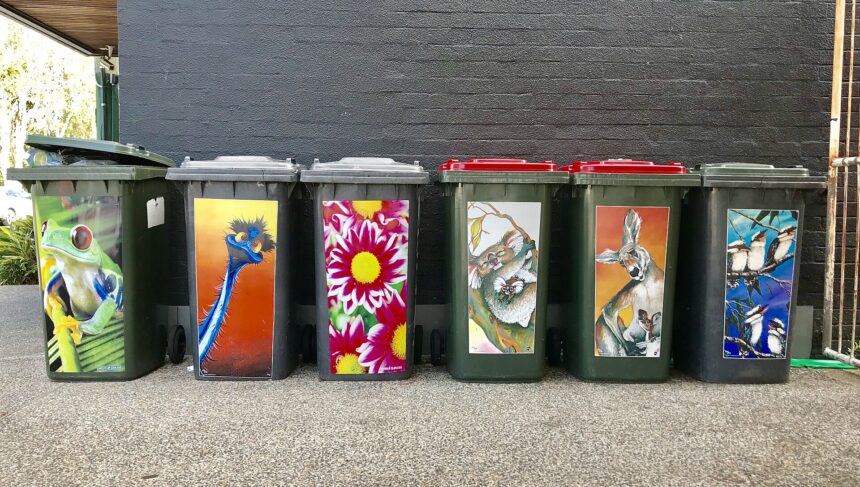
The Council’s “What goes in my bins?” page says Council supplies recycling, general waste and garden waste recycling services. The Council’s pages refer to these as the red bin (general waste), the yellow bin (recycling) and the green bin (garden waste). At 9 November 2026, the Council’s bin collections page said general waste bins have a red, dark green or dark grey lid, that the remaining dark green and grey lids were being replaced with red ones. It adds that the changeovers commenced in April 2025. The same page says there is no change to bin days because of the lid swap.
Red bin: general waste
The Council’s pages refer to the red bin as the general waste bin. The bin-items page advises bagging up loose rubbish such as dust and kitchen scraps when placing it in the red bin. The Council’s red bin list includes soft plastics, food waste, wrappers and general waste. The same list names asbestos, batteries, gas bottles, chemicals and paint tins as items that cannot go in.
The Council gives cling wrap, chip packets, food wrappers and shopping bags as typical household examples that cannot go in the yellow bin and should go in the red bin.
Yellow bin: recycling
The Council’s Recycling in Brisbane page lists paper, metals (aluminium and steel), cardboard, unbroken glass and firm plastics as accepted items. The “What goes in my bins?” page words its list as paper, cardboard, firm plastics, glass containers and metal containers. The two Council pages therefore word the glass rule differently: the recycling page says “unbroken glass”, while the bins page says “glass containers”. That page names polystyrene, soft plastics, plastic bags, drinking glasses, Pyrex-style containers and light bulbs as items that cannot go in the yellow bin. As listed on Council’s pages, checked 9 November 2026:
- Do not put recycling items in a plastic bag.
- Empty bottles, containers and jars before recycling them, although the Council says you do not have to wash them out.
- Leave lids on bottles, containers and jars, because loose lids are too small to be processed.
- Do not place any broken glass in the yellow bin. The Council says broken glass is a safety risk to staff at recycling facilities and should be wrapped and placed in the red bin.
- Coffee cups can be recycled at participating locations, and can alternatively go in the red bin.
- Empty and intact aerosol cans can go in the yellow bin, but butane gas cans cannot.
After collection, the Council says yellow bin contents go to Visy’s Material Recovery Facility on Gibson Island. There they are sorted into paper, cardboard, plastics, glass, steel and aluminium, and items judged non-recyclable are sent to landfill.

Green bin: garden waste
The Council’s bin-items page says to place all garden waste, including grass clippings, loose into the green bin. It also says not to put garden waste in a plastic bag. The Council’s green waste page lists flowers, grass clippings, small plants, garden prunings, weeds, leaves, palm fronds, loose bark, small branches and bamboo plants as accepted, with items no larger than 10 centimetres in diameter and 75 centimetres in length. The same page says you can’t put food in your green waste bin. The “What goes in my bins?” page adds food scraps, animal waste, loose dirt or fill, treated timber, general waste and recycling to the list of items that cannot go in.
The Council says the collected green waste is taken to its resource recovery centres, shredded, and processed by contractors at composting facilities into mulch or compost. It explains the reason for the service this way: garden waste breaking down in landfill produces greenhouse gases such as methane and carbon dioxide.
On eligibility, the Council’s green waste page, as checked on 9 November 2026, says standalone houses are automatically eligible for the green bin service. As checked on 9 November 2026, the page says apartments, units and townhouses are not automatically included; residents may apply, and Council assesses applications case by case. Where the property has a building manager or body corporate, approval is needed. The page also says schools, kindergartens, churches and businesses may apply, with requests assessed individually.
Items that need somewhere else
Some items are not meant for any household bin. The Council says batteries, medical waste and hazardous waste cannot be safely disposed of in household bins and need specialised collection or disposal. It says most household batteries, including from remotes and toys, and car batteries can be dropped off at its resource recovery centres. Household quantities of clean polystyrene (up to 5 cubic metres) can also be dropped off at those centres, because polystyrene cannot go in the yellow bin.



For an item that is not listed, the Council’s bins page points to its item disposal search tool.
Collection day and putting bins out
The Council’s bin collections page, checked 9 November 2026, says general waste, green waste and recycling are collected at different times of the week. To find your collection day, it says to search the bin collection calendar by address. It also mentions reminders from the Brisbane Bin and Recycling app.
The page also lists these placement rules:
- Put bins at the kerb, or as close as possible, by 5.30am on collection day, and no earlier than 24 hours before collection.
- Keep bin lids closed with the wheels facing your property, and leave at least 30 centimetres between multiple bins.
- Position bins so they are not obstructed by parked cars, and avoid blocking pedestrian pathways or vehicle access.
- Remove bins from the kerb as soon as possible after collection, and no longer than 24 hours afterwards.
The Council’s preparation advice also says to avoid overloading bins (maximum weight 70 kg) and to make sure the lid can close.
If something goes wrong
At 9 November 2026, the Council’s bin collections page said a missed red bin can be reported after 4.30pm on the collection day, and a missed yellow or green bin within 2 working days of the collection day. The same page says the Council can arrange in-home bin collection for residents who are frail or have a physical or sensory disability, where no able-bodied person lives at the address and no neighbour or next of kin nearby can assist.
For related home guides, see our Brisbane gardening guide, our subtropical home tips and our libraries guide.
Frequently asked questions
Can broken glass go in the yellow bin?
The Council’s recycling page, checked 9 November 2026, says not to place any broken glass in the yellow bin, and that it should be wrapped and placed in the red bin.
Can food go in the green bin?
The Council’s green waste page, checked 9 November 2026, says you can’t put food in your green waste bin.
Where do soft plastics like chip packets go?
The Council’s bins page, checked 9 November 2026, says soft plastics such as cling wrap, chip packets, food wrappers and shopping bags cannot go in the yellow bin and should go in the red bin.
When do I put the bins out?
The Council’s bin collections page, checked 9 November 2026, says by 5.30am on collection day and no earlier than 24 hours before collection.