




The Council’s Wynnum Heritage Trail page, read on 13 November 2026 (the downloadable guide is shown as last modified June 2026), describes the trail as a way to explore Wynnum’s rise as a premier seaside retreat. The main trail is 4.4 kilometres with 18 points of interest. It is a loop that begins at the Wynnum Wading Pool Park and ends at the Wynnum Jetty. The page adds that some sections are steep and may not be accessible for people with limited mobility. It also credits the Wynnum Manly Historical Society with contributing images and background information.
The foreshore and the Esplanade
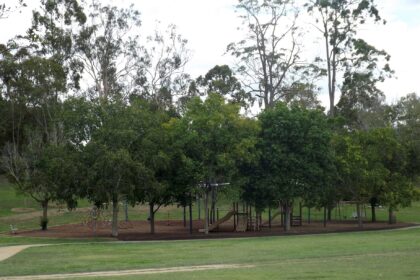
Stop 1, the foreshore parkland and Crown Theatre, begins with the parkland itself: the page says visitors have enjoyed the seaside and parklands beneath the mature trees of Wynnum Wading Pool Park since the 1880s. It says a children’s merry-go-round delighted families in 1902. The page describes the Crown Theatre across the Esplanade as open by 1914 and records that it was demolished in 1983.
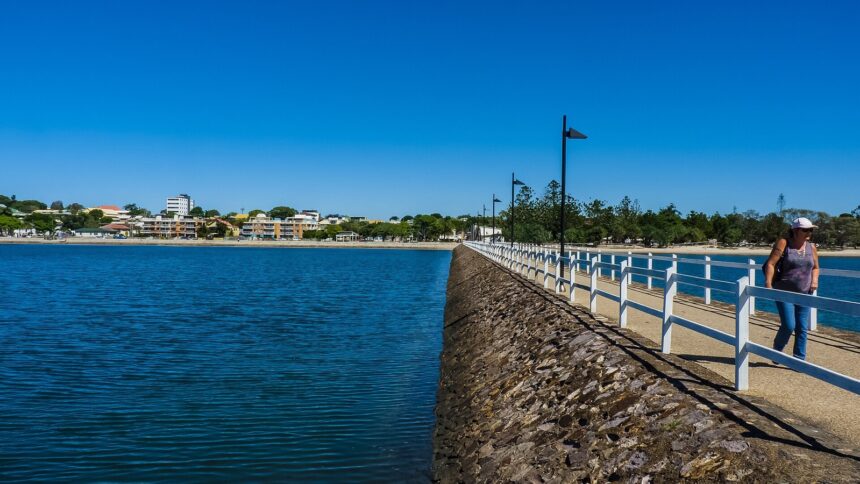
Stop 16, the sea wall near Pine Street, is dated by the page to 1913, when the wall was first built to protect the shoreline and improve foreshore access. It says major upgrades in the 1930s were carried out as part of large public works programs, with the wall strengthened with stone and reinforced concrete. The page adds that much of the stone came from a former Council quarry at Lytton and that more than 2 hectares of mudflats were reclaimed in the 1930s to form the bordering parklands.
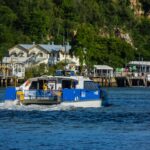
Stop 17, the Wynnum Wading Pool Reserve, is described as built during the 1930s as part of government work schemes designed to support people during the Great Depression. The page says three pipes allow seawater to flow in at high tide, filling the pool naturally. It says the opening was celebrated with a week-long community festival that drew more than 8,000 visitors. Stop 18, the Wynnum Jetty, is described as originally built in 1889, becoming a favourite destination for swimming, strolling and community events. The page says a new bandstand opened in 1917 and that storm damage from the 1954 cyclone led to the jetty being replaced with the structure seen today, known locally as ‘T Jetty’.



Houses, a church and civic buildings
Stop 2, ‘Britannia’ at 75 Waterloo Esplanade, is described as built in 1910 for the Sargeant family, who owned a well-known engineering business producing metalwork for theatres, hotels and public buildings. The page says the home stayed in the family until the late 1970s and continues to be a private residence today. Stop 5, the Shire Clerk’s Cottage at 245 Tingal Road, is described as built in 1890 as one of Wynnum’s few surviving early local government buildings, originally the residence of the Shire Clerk of the Kianawah Divisional Board. The page says the cottage was restored in the 1980s and now forms part of the Waterloo Bay Leisure Centre.
Stop 3, the Church of Christ at 55 Berrima Street, is described as a timber church built in 1925 after a successful tent mission. The page says more than 60 volunteers constructed most of the building in a single day, 12 December 1925, and that the church later closed in 2013 and now operates as a centre providing social support services. Stop 4, the Waterloo Bay Hotel at 75 Berrima Street, is described as a local landmark since 1889, opening the same month the railway reached Wynnum. The page says the hotel is protected on the Queensland Heritage Register for its cultural significance. Stop 11, Guardian Angels Catholic Church at 198 Bay Terrace, is said to have opened in 1905, and the page describes it as built in the Federation Carpenter Gothic style from local hardwood, able to hold up to 400 people. Stop 12, Mount Carmel Convent at 199 Bay Terrace, was built in 1915 for the Sisters of Mercy and designed by Hall and Dods, according to the page.
Related News


Bay Terrace, the post office and community buildings
Stop 9 covers Bay Terrace itself, which the page says has been one of Wynnum’s busiest streets since the 1890s. By the 1920s, it says, the street supported a commercial precinct with butchers, fruiterers, drapers, chemists and banks operating side by side. The page adds that Moreton Bay Girls’ High School once stood on the corner of Charlotte Street; the boarding and day school was founded in 1901. Stop 10, the former Wynnum Post Office at 155 Bay Terrace, is described as serving as the post office from 1924 to 1995. The page says the new post office opened in 1924 with dedicated spaces for mail sorting, telephone exchange operations and staff facilities.
Stop 13, the former Wynnum Ambulance Station at 33 Tingal Road, is described as officially opened in 1927 after strong community fundraising. The page says the station served Wynnum until 1996 and now operates as the Wynnum Ambulance Heritage Museum. Stop 14, the former Wynnum School of Arts at 221 Bay Terrace, is described as opening in 1913 after residents formed a committee in 1911 to establish a venue for adult learning and community events. It says the building accommodated the first Wynnum Manly Show in 1915 and has operated as a community hall since 1977. Stop 8, the former Wynnum Central State School at 105 Florence Street, is described as a 1940s addition to Wynnum’s first primary school, which opened in 1896 after strong community lobbying. The page says the school served generations of families until 2010 and that the former campus now operates as the Wynnum Community Centre.
Stop 6, the Kitchener Memorial and Park at 20 Bridge Street, is said to mark the 1910 visit of Lord Kitchener, one of Britain’s most prominent military leaders. The page says that instead of a formal parade he ordered a large military exercise that simulated an invasion of Moreton Bay, and that 3,000 soldiers saluted him as they marched nearby. It adds that the current granite tablet replaced a timber marker in 1929 and that the memorial was removed during development in the 1960s but reinstated in the 1990s, slightly south of its original location.
Frequently asked questions
How long is the main Wynnum Heritage Trail?
Per the source read on 13 November 2026: The main trail is 4.4 kilometres with 18 points of interest.