


Redland City Council’s local heritage place cards include several for trees, and this guide draws on four of them, read as PDFs on 13 November 2026. Card 18 is titled Redland Bay: Moreton Bay Fig Trees. Card 49 is titled Capalaba: Tallowood Tree. Card 43 is titled Lamb Island: Mango Trees. Card 29 is titled Point Lookout: Seven Norfolk Island Pines.
Moreton Bay fig, Redland Bay
Card 18 says the Moreton Bay fig on Moores Road, Redland Bay, is believed to have been planted by local resident Arwed Ruster in 1942. It says the tree is on the foreshore near the Redland Bay swimming enclosure and Rusters Reserve. The card states that the Ruster family lived on the foreshore and worked as commercial fishermen and crabbers from the mid to late twentieth century. It adds that the Rusters and another local family, the Moores, are believed to have also constructed the swimming enclosure.
In its physical description the card says the canopy of the tree extends approximately 30 metres in diameter. The statement of significance calls the tree locally significant, embodying historic and aesthetic values.
Tallowwood, Capalaba
Card 49 says the tallowwood tree at Redlands IndigiScapes Centre is believed to be over 400 years old. It says the tree has grown crooked as the result of a lightning strike estimated to have occurred about 250 years ago. The card says the tree is visible on the Tallowwood View Trail and is home to a number of native animals including koalas, possums, gliders, birds, insects and reptiles.
According to the card, tallowwood was a popular hardwood used for coaches, in particular wheel spokes, as well as docks and piers. The card says it is likely owing to its unique appearance that this tree was not cut down by timber getters. The physical description estimates that, as of April 2017, the tree was 45-50 metres tall with a chest height circumference of 5-6 metres. The statement of significance describes it as the oldest known tree in the Redlands.
Mango trees, Lamb Island
Card 43 says a group of mature mango trees on Tina Avenue, Lamb Island, is believed to be associated with the Queensland Acclimatisation Society. It describes the society as having played a key role in the nineteenth century in importing and experimenting with exotic plants. The card says the trees are believed to have been planted in 1890 by the society’s then President, Leslie Corrie, a noted architect who served as Brisbane’s mayor from 1902-1903.
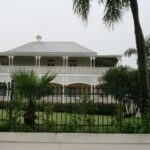
It says four mango trees survive on the road corridor of Tina Avenue, on the site of what later became the early Noyes property. The card says Eric Noyes, a prominent settler in the Southern Moreton Bay Islands, built the Noyes house at 34 Tina Avenue in 1911, and that it served as a post office until 1968.
Norfolk Island pines, Point Lookout
Card 29 describes the Norfolk pines at Point Lookout as a collection of mature pine trees on Moongalba Road and Midjimberry Road. It says members of the Stradbroke Island Progress Association are believed to have planted the trees in the late 1940s to early 1950s as part of a community project. The card says two trees were supplied to each member of the association, who was then responsible for planting and looking after them.
It adds that a newspaper article of 1953 discusses their planting, and that the planting was a deliberate attempt to beautify the Point. According to the card, it is unclear how many of the seven original pines remain, and some current plantings may replace those that have been lost. The card also says that other tree plantings remain in the Redlands, such as the Norfolk Island pines in GJ Walter Park and the palms along Passage Street, Cleveland.
Related reading
Readers interested in listed buildings in Brisbane itself can turn to the Brisbane Heritage-Listed Buildings Guide.
Frequently asked questions
How old is the Capalaba tallowwood tree according to the Council card?
Per the source read on 13 November 2026: Card 49 says the tallowwood tree at Redlands IndigiScapes Centre is believed to be over 400 years old.
Who is believed to have planted the Point Lookout Norfolk pines?
Per the source read on 13 November 2026: Card 29 says members of the Stradbroke Island Progress Association are believed to have planted the trees in the late 1940s to early 1950s as part of a community project.