

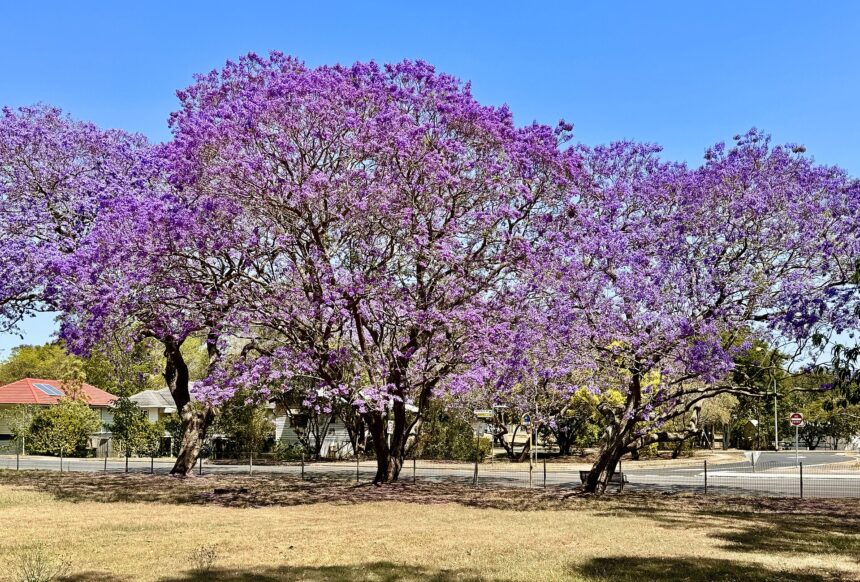
This guide covers where the trees grow, when they tend to flower according to local sources, how they came to be planted, and how to enjoy them without harming the trees. It names no event dates and no prices.
When the jacarandas flower
There is no single official flowering date, and the sources disagree a little. At 9 November 2026, Visit Brisbane (page dated 1 September 2026) describes the display as running from mid-October through early November. The University of Queensland says its St Lucia campus fills with purple every October. The same UQ article was published in 2023, and it notes that warmer weather brought the calendar forward that year, with the first blossoms appearing in mid-September. It adds that last century the trees bloomed at the start of October.
Where jacarandas grow in Brisbane
Brisbane City Council describes the city’s trees as ranging from eucalypts to jacarandas. Its street tree species table lists the jacaranda (Jacaranda mimosifolia) for the coastal, undulating plains, higher land and arterial road landscape precincts. The tree is a native of South America rather than a local species.
At 9 November 2026, Visit Brisbane’s seasonal guide names these places to look:

- New Farm Park: described as one of the most spectacular spots for a picnic under the jacarandas.
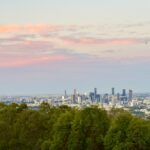
- Wilson Outlook Reserve, New Farm: views of the Story Bridge and the city framed by blooming trees.
- Jacaranda Park, Yeronga: a riverside park awash in violet during the season.
- Orleigh Park, West End: towering jacarandas line the riverbank.
- Taylor Bridge Reserve, Chelmer: a riverside backdrop of jacarandas.
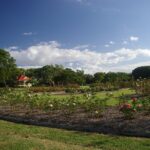
- City Botanic Gardens: purple blooms brighten the heritage gardens and pathways.
- Roma Street Parkland: rare white jacarandas among the plantings.
- University of Queensland, St Lucia: blooms set against the sandstone of the Great Court.
Drivers see a different view. Visit Brisbane says mature trees line Coronation Drive near Toowong, creating a corridor of colour. That list comes from a tourism guide, not a tree survey, so it shows well-known viewing spots rather than every planting in the city.
How the trees came to be here
The story starts at the Botanic Gardens. Walter Hill, the first superintendent of Brisbane’s Botanic Gardens, planted a tree grown from imported jacaranda seed in 1864, and it lived until 1980, when a storm felled it. UQ’s article adds a caution: it says it is not known when the first jacaranda was planted in Australia, and it cites Australian Geographic as saying Brisbane claims the earliest tree, planted in 1864, while the Sydney Botanic Garden tree is dated around 1850. What is documented is the spread that followed. Hill and later curators propagated thousands of trees from its seeds and sent them around Queensland, including to schoolchildren to plant on Arbor Day.

At the university, UQ says Ernest Walter Bick raised and planted more than 130 jacarandas across the St Lucia campus in the 1940s. After royal palms, the jacaranda was the most common tree he planted there. UQ also records that well-tended jacarandas can live for 200 years.
A heritage-listed jacaranda
One tree has its own local heritage entry. Brisbane City Council’s Heritage Places listing describes a mature jacaranda on the corner of Turton Street and Station Road in Sunnybank, where the Oasis Swimming Pool and Gardens once stood. The council’s citation calls it a tree highly valued by the local community for its beauty and historical significance.
Enjoying the trees respectfully
At 9 November 2026, Brisbane City Council’s trees page says street and park trees are protected under the Natural Assets Local Law 2003. The same page says you need permission to prune, remove or interfere with Council trees above and below the ground.
A little student folklore is part of the season at UQ. The university notes the belief that a jacaranda flower falling on your head means you will fail your exam. It is a light-hearted tradition, not a warning, and a good reason to walk slowly and look up.
Frequently asked questions
When do jacarandas flower in Brisbane?
There is no single date. At 9 November 2026, Visit Brisbane describes mid-October through early November, while UQ says October and, in a 2023 article, noted the season had started as early as mid-September that year.
Which Brisbane places have jacarandas?
At 9 November 2026, Visit Brisbane lists New Farm Park, Wilson Outlook Reserve, Jacaranda Park in Yeronga, Orleigh Park, Taylor Bridge Reserve, the City Botanic Gardens, Roma Street Parkland and UQ St Lucia.
Can I prune or damage council jacarandas?
No. At 9 November 2026, Brisbane City Council says you need permission to prune, remove or interfere with Council trees above and below the ground.
Who planted the first jacaranda in Brisbane?
Walter Hill planted a tree from imported seed in 1864, but UQ’s article says it is not known when the first jacaranda was planted in Australia.