



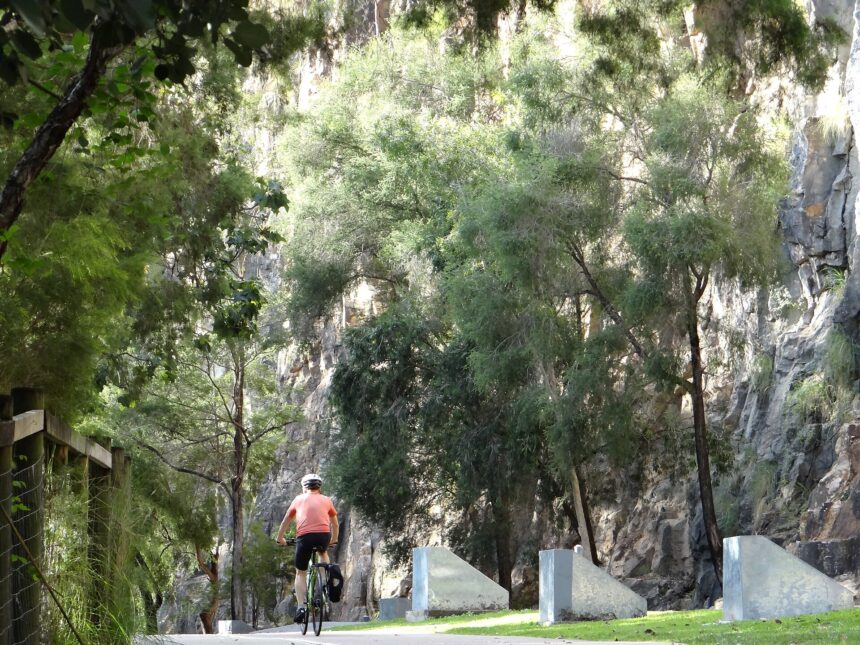
This guide gathers the rules that apply to people riding bicycles in Brisbane, using Queensland Government pages, Brisbane City Council’s bikeway pages and TransLink. Each rule is stated as the source words it at 9 November 2026, with a page’s last-updated date where the page shows one. It covers equipment, where you can ride, the path types you will meet and what drivers must do when passing. For route ideas aimed at children, see Kid-Friendly Bike Paths in Brisbane.
Helmets and equipment
At 9 November 2026 the Queensland Government bicycle page (last updated 1 July 2026) says a person riding a bicycle must wear an approved bicycle helmet or an approved motorbike helmet, and must securely fit and fasten it. At 9 November 2026 the same page (last updated 1 July 2026) says its list of approved bicycle helmet standards includes AS 2063 and AS/NZS 2063. At 9 November 2026 the same page (last updated 1 July 2026) says riders should look for a sticker on the helmet that certifies its compliance with one of the listed standards.
At 9 November 2026 the same page (last updated 1 July 2026) says a person does not need to wear a helmet if they have a doctor’s certificate stating that, for a specific amount of time, they cannot wear a helmet for medical reasons or because of a physical characteristic that makes it unreasonable for them to wear one. At 9 November 2026 the same page (last updated 1 July 2026) says someone with a doctor’s certificate must carry it when riding without a helmet. At 9 November 2026 the same page (last updated 1 July 2026) says a person also does not need to wear a helmet if they are a member of a religious group and are wearing a headdress customarily worn by their group that makes it impractical to wear a helmet. At 9 November 2026 the same page (last updated 1 July 2026) says a bicycle may only carry passengers if it is designed to carry passengers. At 9 November 2026 the same page (last updated 1 July 2026) says a passenger must also wear an approved helmet, securely fitted and fastened, but a paying passenger on a 3 or 4 wheeled bicycle does not have to wear a helmet.
At 9 November 2026 the same page (last updated 1 July 2026) says a bicycle must have at least one working brake and a working bell, horn or similar warning device every time you ride. At 9 November 2026 the same page (last updated 1 July 2026) says at night, or in weather conditions that make it difficult to see, a rider must display lights and a reflector, either on the bicycle or on themselves. At 9 November 2026 the same page (last updated 1 July 2026) says the white light must be clearly visible at least 200 metres from the front of the bicycle and the red light at least 200 metres from the back. At 9 November 2026 the same page (last updated 1 July 2026) says the red reflector must be clearly visible at least 50 metres from behind when a vehicle’s headlights shine on it.
Where you can ride
At 9 November 2026 the same page (last updated 1 July 2026) says riders can choose whether or not to ride in a bicycle lane where one is provided. At 9 November 2026, Brisbane City Council’s bikeway safety page says bicycle lanes are dedicated on-road bicycle routes, and the painted green surface improves awareness and traction in wet conditions. At 9 November 2026 the same Council page says riders can use bike boxes to wait at a red light in front of vehicles, to be seen more easily by other road users.
At 9 November 2026 the same Council page says a bicycle can be ridden on footpaths in Queensland unless otherwise signed. At 9 November 2026 the same Council page says on a footpath riders should give way to all walkers and sound their bell when approaching them. At 9 November 2026 the same Council page says where a no-bicycles sign applies, as in public squares and malls such as Queen Street Mall, riders must dismount and walk through.


At 9 November 2026 the Queensland Government cyclists page (last updated 5 June 2026) says two riders may ride side by side on a road as long as they are not more than 1.5 metres apart. At 9 November 2026 the Queensland Government bicycle page (last updated 1 July 2026) says holding a mobile phone in your hand or resting it on any part of your body while riding is illegal, even if you are stopped in traffic. At 9 November 2026 the Queensland Government bicycle page (last updated 1 July 2026) says a rider must use a hand signal when turning right. At 9 November 2026 Brisbane City Council’s bikeway safety page says, under Queensland legislation, the Queensland Police Service is the only authority that can enforce road rules or the rules for cycling or using an e-mobility device.
The path types you will meet
At 9 November 2026 the same Council page says on shared pathways riders keep left, avoid blocking the path and must give way to pedestrians. At 9 November 2026 the same Council page says riders approaching pedestrians should slow down and sound their bell. At 9 November 2026 the same Council page says on a separated pathway one side is for pedestrians and the opposite side is for riders. At 9 November 2026 the same Council page says it also lists bicycle-only pathways, where people can ride but cannot walk.
At 9 November 2026, Council’s bikeways page describes the Bicentennial Bikeway as an off-road 4.8 km pathway along the Brisbane River from Toowong to the CBD, with separate bike and pedestrian paths. At 9 November 2026 the same Council bikeways page describes Veloway 1 as a dedicated 3-metre-wide bikeway for bikes and e-mobility devices that runs from South Brisbane to Slacks Creek. The Brisbane Riverwalk Guide covers the riverside paths in more detail.
What drivers must do when passing you
At 9 November 2026 the Queensland Government cyclists page (last updated 5 June 2026) says the minimum passing distance for motorists is 1 metre when passing a rider in a 60 km/h or less speed zone. At 9 November 2026 the same page (last updated 5 June 2026) says the minimum is 1.5 metres where the speed limit is more than 60 km/h. At 9 November 2026 the same page (last updated 5 June 2026) says a driver is passing a rider when both travel in the same direction, even if the rider is in a separate lane including a bicycle lane. At 9 November 2026 the same page (last updated 5 June 2026) says the passing rule does not have to be followed when travelling in opposite directions.


At 9 November 2026 the same page (last updated 5 June 2026) says when it is safe, a driver passing a rider is allowed to drive over centre lines, including double unbroken centre lines, on a two-way road. At 9 November 2026 the same page (last updated 5 June 2026) says if it is not safe to pass, the driver must wait until it is safe. At 9 November 2026 the same page (last updated 5 June 2026) says fines and demerit points may apply to drivers who fail to follow the passing rules.
Taking a bike on public transport
The rules below are TransLink’s wording at 9 November 2026, and TransLink can change them. At 9 November 2026, TransLink’s cycling and walking page says bikes and personal mobility devices, including e-scooters, are not permitted on bus or tram services. At 9 November 2026 the same TransLink page says a folding bike that can be carried in a bag no bigger than 90 cm x 70 cm x 36 cm can travel on any service.
At 9 November 2026 the same TransLink page says you can travel with your bike or personal e-scooter onboard trains at any time. At 9 November 2026 the same TransLink page says to board using the first or last carriage of six-car trains only. At 9 November 2026 the same TransLink page says to ensure only two people with bikes or e-scooters are in the first or last carriage at any time, or wait for another train. At 9 November 2026 the same TransLink page says bikes and personal mobility devices, including e-scooters, are not permitted on railbuses. See Brisbane Trains Explained for the wider rail picture.
At 9 November 2026 the same TransLink page says bikes, scooters and other personal mobility devices are permitted on CityCat and ferry services subject to space availability and staff discretion. At 9 November 2026 the same TransLink page says all wheeled devices other than motorised mobility aids must be walked onto the ferry. The Brisbane CityCats and Ferries Guide has more on those services.
Frequently asked questions
Do I have to wear a helmet when riding a bike in Queensland?
At 9 November 2026 the Queensland Government bicycle page (last updated 1 July 2026) says a person riding a bicycle must wear an approved bicycle helmet or an approved motorbike helmet, securely fitted and fastened. It says a person does not need to wear a helmet if they have a doctor’s certificate stating that, for a specific amount of time, they cannot wear a helmet for medical reasons or because of a physical characteristic that makes it unreasonable for them to wear one. It also says a person does not need to wear a helmet if they are a member of a religious group and are wearing a headdress customarily worn by their group that makes it impractical to wear a helmet.
How much room must a driver give me when passing?
At 9 November 2026, the Queensland Government cyclists page (last updated 5 June 2026) says the minimum is 1 metre in a 60 km/h or less speed zone and 1.5 metres where the speed limit is more than 60 km/h.
Can I ride on a footpath in Brisbane?
At 9 November 2026, Brisbane City Council’s bikeway safety page says you can ride a bicycle on footpaths in Queensland unless otherwise signed. It says riders should give way to all walkers and sound their bell when approaching them.
Can I take my bike on a bus?
At 9 November 2026, TransLink says bikes are not permitted on bus or tram services, although a folding bike in a bag no bigger than 90 cm x 70 cm x 36 cm can travel on any service.